



PROVISIONAL CONCEPTS (Designed by Robert Ferry & Elizabeth Monoian)
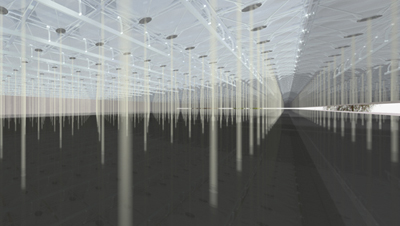
Since the competition has not yet been held, the principal artists have created some conceptual images to evoke ideas about what potential LAGI installations could look like and how many homes they could power.

Korfakhan Necklace: 30MW
Consists of 832 wave energy collecting devices that resemble in their above-water sculptural form the individual ornaments of a necklace. The long tendril shapes that they form follow the flow of the waves to the shore and are as ever-changing as the movement of the water. It is this movement of water that creates the energy inside the body of each amulet where fluid is pressurized to run a turbine generator. The energy is then transmitted along to the outermost band and to the shore where it is fed into the energy grid where it has the potential to power the approximately 15,000 households of this East coast city.

Glacier Bay Projection: 156KW
The renewable energy media sculpture is a video LED wall, with live streaming footage of Glacier Bay National Park in Alaska visible 24 hours a day on Sheikh Zayed Road on the route from Dubai to Abu Dhabi. The imagery will be ever changing as the wild landscape shifts minute by minute. The South-facing support structure contains a vast array of PV panels at a 30 degree angle. The camera in Alaska will be powered by a Wind Turbine. This piece could potentially power itself as well as the petrol stations and street lights along the highway.


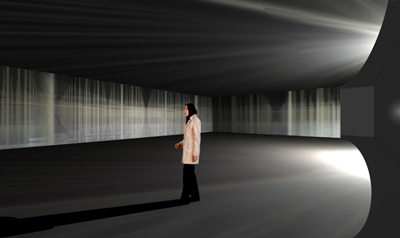
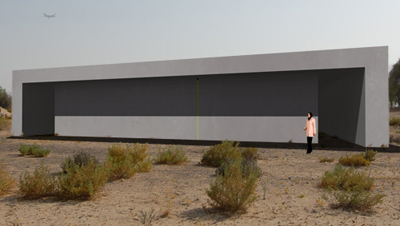
Ibn Al Haytham Pavilion for Mushrif Park: 150KW
The first camera obscura was built by Arab scientist Abu Ali Al-Hasan Ibn Al-Haytham, born in Basra (965-1039 CE), who carried out practical experiments on optics in his “Book of Optics”. In his experiments, Ibn Al-Haytham used the term Al-Bayt al-Muthlim, translated in English as dark room. In the experiment he undertook in order to establish that light travels in time and with speed, he wrote: “If the hole was covered with a curtain and the curtain was taken off, the light traveling from the hole to the opposite wall will consume time.” He reiterated the same experience when he established that light travels in straight lines. A revealing experiment introduced the camera obscura in studies of the half-moon shape of the sun’s image during eclipses which he observed on the wall opposite a small hole made in the window shutters.
Concentrated photovoltaic (CPV or HPVC) technology concentrates sunlight through a lens onto a high performance solar cell, thus increasing the electricity generated over conventional PV panels. Typical photovoltaic panels only convert about 10 to 15 percent of incoming light into energy. CPV cells utilize multijunction photovoltaics which can reach efficiencies of 40 percent. Typically the CPV solar cell lies directly beneath the fresnel lens or parabolic mirror concentrator.
In the Ibn Al-Haytham Pavilion, this type of system is modified to create beams of vertical light with the power of 800 suns by concentrating sunlight through fresnel lenses at the roof. These beams are then re-concentrated at the raised floor level by a second fresnel lens field and onto the CPV cells which are arrayed in a naturally cooled plenum space at ground level.
Download the Ibn Al Haytham Design Boards

Clean Energy Construction Precedents
(1MW is equivalent to the power required to run approximately 500 households.)
Solar Power Tower, Seville, Spain: 11MW
http://ec.europa.eu/energy/res/sectors/doc/csp/ps10_final_report.pdf
A 40 story concrete tower surrounded by fields of photovoltaic panels is the first stage of Europe’s first commercial solar power station, which recently went into operation outside Seville, Spain.
ADFEC Shams 1: 100MW
http://renewableenergydev.com/red/solar-energy-shams-1-csp-plant
This project highlights the commitment already being made by the government to
support alternative energy generation in the UAE.
The Solar Mission Project, Australia: 200MW
www.enviromission.com.au
An example of an innovative approach to harnessing the energy of the sun which runs
a turbine off of the wind that is generated by the temperate difference between the greenhouse at the base and the much lower ambient temperature at the top of a tall chimney structure.
Solar Energy Generating Systems, USA: 354MW
www.fplenergy.com/portfolio/pdf/solar_factsheet.pdf
This is the largest solar energy generating facility in the world and is located in the
Mojave Desert of California.
Land Art Precedents
Walter De Maria, The Lightning Field (1977), Quemado, New Mexico
www.lightningfield.org
Already utilizing a source of natural energy (though not collecting it for redistribution), this installation is an apt example. The Lightning Field is a work of Land Art situated in a remote area of the high desert of western New Mexico, USA. It is comprised of 400 polished stainless steel poles installed in a grid array measuring one mile by one kilometer. The poles—two inches in diameter and averaging 20 feet and 7 inches in height—are spaced 220 feet apart and have solid pointed tips that define a horizontal plane. This is a sculpture to be walked in as well as viewed.
Robert Smithson, Spiral Jetty (1970), Great Salt Lake, Utah
www.robertsmithson.com
Robert Smithson’s Spiral Jetty is located on the Great Salt Lake in Utah. Using black basalt rocks and earth from the site, the artist created a coil 1,500 feet long and 15 feet wide that stretches out counter-clockwise into the translucent red water. One could imagine a similar work that has the added benefit of harnessing the energy of currents or collecting the inherent electronic impulses of salt water.
Storm King Art Center
www.stormking.org
Together with the Dia Center for the Arts, Storm King has helped to nurture the development of artists in the field of Environmental Installation Art.