bLAGI HOME

Atelier dna
Designed for Site #3 in Abu Dhabi, adjacent to Masdar City Site.

Concept and Design: Darío Núñez Ameni and Thomas Siegl, with Atelier dna
Narrative and Poetics: Gabrielle Jesiolowski
Structure and Engineering: Radhi Majmudar PE, with ISSE Innovative Structural and Specialty Engineering
Ecology and Renewable Energy Strategy: Ian Lipsky, with eDesign Dynamics


Design Submission for the 2010 Land Art Generator Initiative Design Competition
Second Place Mention from the Jury

Artist’s descriptive text:
MASDAR/WINDSTALK

Our project starts out as a desire, a whisper, like grasping at straws, clenching water.

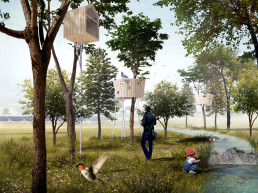
Our project takes clues from the way the wind caresses a field of wheat, or reeds in a marsh; our hair on a gusty afternoon.

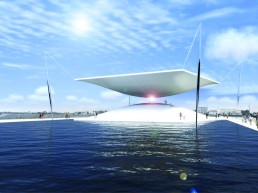
Our project consists of 1203 stalks, 55 meters high, anchored on the ground with concrete bases that range between 10 to 20 meters in diameter. The stalks are made of carbon fiber reinforced resin poles, 30 cm in diameter at the base and 5 cm at the top. The top 50 cm of the poles are lit up by an LED array that glows and dims depending on how much the poles are swaying in the wind. When there is no wind–when the poles are still–the lights go dark.

The bases that support the poles are arrayed along the site following a logarithmic spiral, the kind we see in the center of a sunflower. The bases all
touch each other, forming a kind of carpet, a kind of fabric.

The bases are shaped like vortices–no two vortices are identical–When it rains, the rain water slides down the slopes of the bases to collect in the spaces between, concentrating scarce water. Here, plants can grow wild.

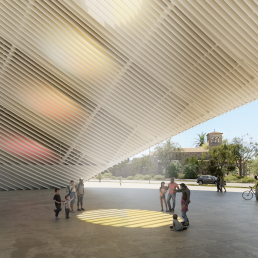
You can walk on the bases of the poles, you can traverse the whole site by walking from base to base. You can lean on the slopes, lie down, stay awhile and listen to the sound the wind makes as it rushes between the poles.

But our project isn’t just desire.

Within each hollow pole is a stack of piezoelectric ceramic discs. Between the ceramic disks are electrodes. Every other electrode is connected to each other by a cable that reaches from top to bottom of each pole. One cable connects the even electrodes, and another cable connects the odd ones. When the wind sways the poles, the stack of piezoelectric disks is forced into compression, thus generating a current through the electrodes.

Within each concrete base is a hollow chamber that houses a torque generator.

The generator converts the kinetic energy of the swaying poles into electrical energy by way of an array of current generating shock absorbers, which convert energy produced by the forced movement of fluid through the shock absorber cylinders.

The electricity that our project generates isn’t constant, it depends on the wind.

To compensate we make a kind of battery, a capacitor, a way to store energy:

Below the field of poles are two very large chambers, chambers as large as the whole site. The chambers are shaped like the bases of the poles but inverted, then inverted again, and again and once more.

There’s upper chamber and a lower one beneath. When the wind blows, part of the electricity generated powers a set of pumps, the pumps move water from the lower chamber to the upper one. When the air is still–when there is no wind– the water from the upper chamber flows down again turning the pumps into generators.

Our project is conceptual, yet It is based on a set systems that already exist and work. Our project attempts to combine these systems into a coherent synergetic
whole.

Notes:
The shape of our Windstalks should be optimized to behave as chaotically as possible, they should flutter, oscillate, vibrate. Computer generated simulations can aid in determining and optimizing the best profile for maximizing movement and variation.

We roughly estimate that the overall output of our project is comparable to that of a conventional wind turbine array. While a single wind turbine that is limited in height to 55 meters may produce more energy than one of our Windstalks, our Windstalks can be packed in denser arrays.

low-res version PDF of submitted boards

Tweet this!Tweet this!

By Antonio Maccà and Flavio Masi
Designed for Site #3 in Abu Dhabi, on Airport Road adjacent to Masdar City.

Antonio Maccà and Flavio Masi
Design Submission for the 2010 Land Art Generator Initiative Design Competition

Artist’s Descriptive Text:
The Photovoltaic Solar System on December 2nd 1971: The Day of Birth of the United Arab Emirates

The project is an artistic interpretation of the Solar System as well as an ideal symbol of the United Arab Emirates: the position of the planets corresponding to the configuration of the Solar System on December 2nd 1971, the day in which the United Arab Emirates were founded.

The environmental installation is a metaphor of the Seven Emirates, represented in form of a Sun with six planets guided by the spiritual sphere (the Crescent): in a work that ideally puts art at the disposal of the history, both past and present, of the Country it aims to celebrate.

The artwork is also meant to create a new iconic sun for the City of Abu Dhabi: the astronomic Sun radiating energy to the new photovoltaic sun, which will generate light and electric power for the future urban area of Masdar.

The PV sun works as the attracting element and symbolizes the unity and infinity of the cosmo: the endless geometrical pattern of the golden surface, with its timeless perfection and purity, represents the starry sky and creates a spherical motif of both light and shade, thus dematerializing the sun and emphasizing its transparency. The PV sun is to be completed by means of LEDS that will light up its skin throughout the night.

Antonio Maccà and Flavio Masi

The project suggests a contemporary landmark defining a unique relationship between nature, art and science. It is structured as a scheme made of circles that defines the entire area according to one single principle. The almost concentric traces, drawn with natural stones on the land, symbolize the orbits described by the planets around the Sun and will be easily recognizable from great distances, also by the landing planes of the nearby airport.

The land artwork is positioned in the plane barycentric area of the almost triangular site, with the largest trajectory tangential to the boundary limits of the roads, thus establishing an optimum relationship with the surrounding open spaces.

The static concentric structure of the project is vitalized by the planets, ideally seeming to roll all around the site on the orbits, thus creating a complex of dynamical sculptures. The spheres are all different, varyingin structure, dimension, colour, transparency degree and photovoltaic technology. The dimensions of the planets will depend on construction costs and on the required amount of energy to beproduced.

The Earth is the only place in the universe where life is known to exist: life on earth is therefore symbolized by an already existing tree,around which will be constructed a photovoltaic greenhouse with the serigraphy of the continents. The Moon, its satellite, is endowed on the surface with an opening in shape of a Crescent.

The founding conceptsfor the other planets are suggested by astronomic phenomena, such as: the presence of atmosphere in a planet for the double concentric spheres, the impact craters on the surface for the sphere composed by circles, the ring system for the split globe, the cloud bands of a gas giant for the photovoltaic solar shading sphere and the eclipse for the black planet.

The planets, like pavilions, can host entertaining and educational facilities, such as temporary exhibitions or public activities, in order to create a new place of collective identification and a fascinating cultural site.

In this way, uniting the rationality of the concentric orbits with the multiplicity, the differentiation and the interaction of the planets, the art installation will become an open system in dialogue with the environment.

The structure of the complex will offer a flexible constructive system, composed by geodetic steel structures to which photovoltaic panels will be applied.

The installation is a representation of the Solar System composed by photovoltaic solar systems. It will capture energy from the sun and convert it into electricityusing innovative typologies of polycrystalline thinfilm photovoltaic technologies: thin film with an active layer of copper, indium, gallium and selenide (CIGS) and thin film solar cells with multycrystalline silicon (mc-Si). The photovoltaic panels are different for each planet, according to their different materials, shapes, colours and textures. They have maximum outputs even in high ambient temperatures and with diffuse light, and convert all the surfaces of the sculptures into energy generators.

The land artwork itself represents an astronomic macro-nature in the landscape. The strategy of creating stony orbits on the natural surface and superposing the photovoltaic planets on them defines a soft intervention that doesnothave any negative impact on the natural surroundings and doesnot produce any effect at all on the ecosystem of the site.

The aerodynamic sculptures communicate a sensation of weightlessness, both visually and physicallytouching the landscapelightly. Each sculpture has an extremely limited contact zone on the ground, thus preserving the nature of the site and integrating itself with the local ecosystem.

The technical solutions and the environmental compatibility establish the future sustainability of the park, creating a scientific artwork that will produce effects of wonder and peacefulness in harmony with Nature, for a future of renewable energy.

Antonio Maccà and Flavio Masi

Antonio Maccà and Flavio Masi

low-res version PDF of submitted boards

Tweet this!Tweet this!

By Martina Decker and Peter Yeadon (Decker Yeadon LLC, New York City).
Designed for Site #1 in Dubai, adjacent to Ras Al Khor Wildlife Sanctuary.


Design Submission for the 2010 Land Art Generator Initiative Design Competition

Artist’s descriptive text:
Light Sanctuary : An empowered landscape for the UAE

What if a mirage were real? The precise optical effects of reflection, diffusion, and inversion that are an essential feature of the desert landscape have acquired a reputation of mystery and even of deception. This proposal, instead, brings clarity, utility, lightness, and authentic meaning to the idea of the mirage: of a scintillating fluid structure seeming to float above the dry landscape, balancing and enhancing its calligraphic geography and fierce beauty.

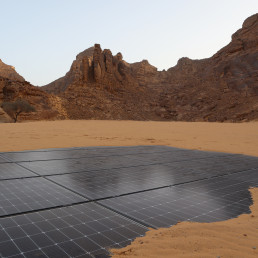
To do this, we propose not the collection or distribution of water (the conventional illusion suggested by the desert’s optical effects), but instead the production of electrical energy. The project is a sea of ribbons, incorporating photovoltaic technology, touching lightly on the land, reaching out toward the water’s edge at the Ras Al Khor site. Forty kilometers of ribbons, some 80,000 square meters in total surface area, are raised like a continuous flag or banner, a minimum of six meters above grade. These ribbons, each 10m in height, are poised on a distributed network of strong but slender masts, structurally recalling the historical inheritance of fabric and nomadic architecture.

The ribbons are folded and swooped and nestled and caressed into complex waveforms that evoke natural landscape formations of desert and coastline, sand and water — but which are actually technologically optimized for the oriented exposure of their surface to light, heat, and shade. Their surfaces are continuous laminations of third-generation photovoltaics, an innovative ecological alternative to conventional silicon panels. This elegant thin-film technology has an inherent beauty: the surprising amber and pomegranate tones of its translucent surface evoke the resins, silica, and clays that are part of the desert’s natural botanical and geological resources.

This dye-sensitized solar cell technology exploits the light-absorbing properties of the organic dyes that provide its rich color. Within the thin laminations of the flexible membrane, an organic dye derived from botanicals like pokeberries and other plants enables solar energy to incite a titanium dioxide electron exchange, thus producing direct current that is harvested by transparent polymer electrodes.

Mature thin-film solar technologies are already available from various manufacturers (including Konarka, G24 Innovation, and others), and are well suited to this project and the requirements of its unique environment. Unlike older silicon-based panels, these translucent membranes can absorb light across 140º relative to their surface. This extraordinarily wide angle of available light absorption enables them to work well when installed vertically, which minimizes the accumulation of dust and sand; further, their flexible properties enhance their ability to vibrate small particles off the photovoltaic surface — to essentially be self-cleaning.

Although they are visually subtle, dye-sensitized solar cells are remarkably durable and stable in a wide range of climate and weather conditions, including extreme heat and extreme temperature change. Whereas the efficiency of older silicon-based solar panels falls as temperatures rise, the proposed organic dye technology becomes increasingly efficient with increases in temperature. A number of variables, such as reflected light from the desert floor and local atmospheric factors, will influence the operational generation of energy. Calibrated optimally, the ribbon array as proposed would generate 4592 megawatt hours (16530 gigajoules) of energy annually — an educationally visible expression of a contribution to the invisible electricity grid, and a comprehensible percentage of power production within the United Arab Emirates.

While it is informed by globally cutting-edge technology, this intervention is closely sensitive to the local presence, geology and living landscape of its setting. The entire land art installation floats as a sinuous gesture across 40 hectares, a little over half of the available Ras Al Khor site. The geometry and tectonics of the structure minimizes its ecological impact, yet optimizes its technological efficiency. Other than a carefully calibrated network of narrow supports, it touches the ground only at one concentration point in its waveform pattern, leaving the local desert surface, plant and animal habitats, and surface water flows essentially undisturbed and unimpeded.

The large surface area of the ribbons gathers abundant solar energy and directs its power toward this concentration point, protected and expressed as a single strong sculptural structure, which houses inverters and transformers, and also serves as the plinth for a raised viewing platform. This elliptical platform is approached by a ramped and curving path that guides the viewer up through a shaded forest of supports, up through a sea of amber, and up to a promenade just above the ribbons. From the adjacent Route 44 Highway and landscapes, Light Sanctuary has all the mystery and promise of a mirage at its most beautiful and powerful; from the ramp, one experiences a unique and contemplative visual immersion; from the viewing promenade, the visitor authentically perceives the modern reality and energetic potential to be seen in the city skyline of Dubai.

low-res version PDF of submitted boards

Tweet this!Tweet this!

Starting today, we will be posting all of the entries, one-by-one, here on the Land Art Generator Initiative blog. The order of the posts will be random and have no bearing on the ranking of the projects with the jury. As you know from following this blog, the winner has been contacted. The announcement will be made at the World Future Energy Summit in Abu Dhabi this coming January and the identity of the winner will remain a secret until then.

Tweet this!Tweet this!

We are very pleased to announce:
The prize for the winning design of UAE Land Art Generator Initiative’s (LAGI) first international design competition will be sponsored by Masdar, Abu Dhabi’s multi-faceted initiative advancing the development, commercialization and deployment of renewable and alternative energy technologies and solutions.

The winning team will be awarded the prize at the 2011 World Future Energy Summit in Abu Dhabi (January 17-19). The award ceremony will take place as part of the Land Art Generator exhibition at Masdar stand at WFES.

A select jury panel consisting of 20 local and international artists, architects, academicians, industry leaders and writers have reviewed the entries and a winner has been decided. The winning artist will be notified on Monday, August 9th, but the decision will remain unannounced until the ceremony at the World Future Energy Summit. All the designs will be posted here on the Land Art Generator Initiative blog site—about three per week during the autumn.

LAGI is a first-of-its-kind interdisciplinary collaboration that has brought together global artists, architects, scientists, landscape architects, and engineers to design energy-generating public art installations to be considered for construction in Dubai and Abu Dhabi. The international competition, which closed on June 4, 2010, received entries from over 40 countries. Each sculpture will continuously distribute clean energy into the electrical grid with the potential to provide power to thousands of homes.

We live in a world that cross-culturally puts a high emphasis on design. As energy generation necessarily comes in closer proximity with the real estate that it powers, issues of aesthetics that drive public acceptance are becoming more and more debated. We believe that it is not only possible, but also necessary that renewable energy generation be integrated into the fabric of our constructed environments. In so doing, these installations must react responsibly to their role as permanent additions to our shared experience. In their most lofted role, they will also serve the more cultural function as works of art that can inspire and educate.

The residents of the communities in which these artworks are constructed will be pleased to know that some percentage of the power that is being used by the lights in their home has been generated cleanly by works of art. Sustainability in communities is not only about resources, but it is also about harmony.

Masdar is Abu Dhabi’s multi-faceted initiative advancing the development, commercialization and deployment of renewable and alternative energy technologies and solutions. Masdar is driven by the Abu Dhabi Future Energy Company (ADFEC), a wholly owned company of the government of Abu Dhabi through the Mubadala Development Company.

Tweet this!Tweet this!

Wind Lens

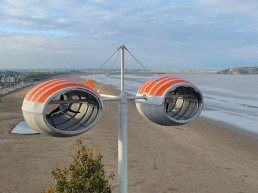
News this week from the Renewable Energy International Exhibition in Yokohama, Japan highlights some visually and technologically interesting new turbine designs for offshore wind power.

The hoop that surrounds the blade structure acts like a magnifying lens to increase the speed of the wind at the center of the circle. We can’t claim to understand the physics behind this effect, but the news reports cite verifications experiments that have been conducted and it appears that the project is getting support for construction in Japan.

The addition of more blades and a hoop around them makes the turbines look just a little bit more like the London Eye than your standard three blade HAWT. Will this aesthetic appeal to more people and lead to a greater acceptance of wind turbines that are located in view of highly populated areas? Perhaps if they can offer rides in gondolas that run around the hoops…

Tweet this!Tweet this!

In the UAE and in many parts of the world, these public water fountains are found everywhere. There are tens of thousands of them in cities such as Dubai and Abu Dhabi. They typically pull water from the domestic line of a villa or public building such as a mosque. They provide people on the street with access to clean potable water and are an important amenity for cities, especially in hot climates.

But what if they didn’t have to pull from the municipal water supply? What if they could be mass-produced as stand-alone units? By using off-the-shelf technology available now for water-from-air systems and combining it with a simple solar power generation system, we could remove these from the city’s water supply infrastructure. This would mean hundreds of thousands of gallons per day in savings from desalination systems and depleting aquifers and would do far more than any water conservation strategy aimed at personal water use behaviors of consumption (such conservation messages are of course still vital and indispensable).

Water-from-air systems such as those available from companies like Liquid of Life and others could be integrated very easily into city-funded replacement units for these street-side fountains. They work great, especially in humid climates like those in the GCC. This is something that could be accomplished within two years time and could save cities like Dubai from having to add capacity to the desalination systems which do great harm to the fragile marine ecosystems when their super-brine wastewater outfall over time increase the salinity of the gulf waters. See here and here.

Thanks to Richard Wagner, who showed me some of his great photos of these fountains the other day which got me thinking about this subject.

Tweet this!Tweet this!

I was reading yesterday this section (Chapter 9 – Two Images of Technology) in Murray Bookchin’s excellent study on the “emergence and dissolution of hierarchy.” It is so clear and so relevant that I would like to quote it here in some length. The lessons that are so undeniably prescient in the words below and which are so important to the success of our collective endeavor toward the proliferation of healthy societies in the 21st century are very sadly ignored by many today.

In Bookchin’s words are some very serious lessons about one of the most important choices that is being made by decision makers today: what is the portfolio of our near-term energy future and how are we going to build a strong new foundation for a sustainable, non-polluting infrastructural system that will allow our fast-growing population universal access to lives of quality and value in the decades to come?

If while reading this, one keeps in mind so many of the current topics of debate in popular culture, it begs to question so many of the basic assumptions that are majority departure points for all of these conversations. When we knowingly engage in activities that are harmful to the balance of our ecosystems in order that the near-term growth rate on our dividends can be maintained and/or in order that we might have access at the consumer level to inexpensive fashions and goods or creature comforts, we are doing so in violation of very deep moral traditions that have roots into all religions and systems of ethics out of which modernity was born. It is in essence a betrayal of the best of humanity to continue to squander our potentiality for good. The right path continues to present itself despite our best efforts to ignore it. What is certain is that it not the easy path. But what is also certain is that the one we are on right now is leading nowhere very good.

Bookchin begins by setting the recent historical stage of humanity’s relationship with technology:

In trying to examine technology and production, we encounter a curious paradox. We are deeply riven by a sense of promise about technical innovation, on the one hand, and by a thorough sense of disenchantment with its results, on the other. This dual attitude not only reflects a conflict in the popular ideologies concerning technology but also expresses strong doubts about the nature of modern technological development itself. We are puzzled that the very instruments our minds have conceived and our hands have created can be so easily turned against us, with disastrous results for our wellbeing—indeed, for our very survival as a species.

It is difficult for young people today to realize how anomalous such a conflict in technical orientation and imagery would have seemed only a few decades ago. Even such a wayward cult hero as Woody Guthrie once celebrated the huge dams and giant mills that have now earned so much opprobrium. The people whom Guthrie and his radical companions of the 1930’s addressed had a deep reverence for technology, specifically those skills and devices that we place under the rubric of “technics.” New machines, like artistic works, were objects of display that radiantly enraptured not only the connoisseur of futurism, the manufacturer, and the specialist, but the general public in all walks of life. Popular American utopias were unreeled in monumental technocratic images; the embodied power, a preening mastery of nature, physical gigantism, and dazzling mobility. The largely technical “New World of Tomorrow,” celebrated in the last of the truly great fairs—New York World’s Fair of 1939—fascinated millions of visitors with its message of human achievement and hope. In fact, technics had become as much a cultural artifact as a mechanical one. The early part of the century witnessed the emergence of an intensely social and messianic art (Futurism, Expressionism, the Bauhaus, to cite the most celebrated ones) that was overwhelmingly technological in its exhortations and in its derogation of more leisurely, reflective, craft-oriented, and organic traditions.

The hold of technics on the social imagery of that time was more fetishistic than rational. Even the First World War, which witnessed a massive use of the new technological armamentarium to slaughter millions of people, did not dispel this technical mythos. Only in the sequelae of the second of these worldwide conflicts, with all its terrifying results, did we begin to witness chilling doubts in the popular mind over the wisdom of technical innovation. Nuclear weaponry, perhaps more than any other single factor, has created a popular fear of a “technics-run-wild.” The 1960s began to exhibit a pronouncedly anti-technical bias of its own that has since turned into a complex duel between “high” and “hard” technologies (those associated with fossil and nuclear fuels, industrial agriculture, and synthetics) and the so-called “appropriate” or “soft” technologies (those structured around solar, wind, and hydraulic sources of energy, organically grown food, and human-scale, craft-like industries).

What clearly renders “appropriate” technology increasingly attractive today is not any popular celebration of its achievements of promise; rather, it is a growing fear that we are irretrievably committing ourselves to destructive systems of mass production and widespread problems of environmental pollution. The artistic messiahs of a technocratic society are gone. Humanity now seems to feel that technology has ensnared it; it has the mien of a victim rather than a beneficiary. If the first half of the century witnessed the emergence of “high” technology as a popular “art-form” because the great majority of the industrialized world’s population still lived in small communities with almost antique technical artifacts, the end of the century is witnessing the emergence of “appropriate” technology as a popular “art-form” precisely because “high” technology has placed a gilded cage over the suffocating millions who now clutter the cities and highways of the western world.

The grim fatalism slowly permeating western humanity’s response to technics derives in large part from its ethical ambivalence toward technical innovation. The modern mind has been taught to identify technical sophistication with a “good life” and, to a large extent, with a social progressivism that culminates in human freedom. But none of these images has been suitably clarified, at least not from a historical perspective. Today, by far the great majority of people view the “good life” or “living well” (terms that date back to Aristotle) as a materially secure, indeed highly affluent life. Reasonable as this conclusion may seem in our own time, it contrasts sharply with its Hellenic origins. Aristotle’s classic distinction between “living only” (a life in which people are insensately driven to the limitless acquisition of wealth) and “living well” or within “limit” epitomizes classical antiquity’s notion of the ideal life, however much its values were honored in the breach. To “live well” or live the “good life” implied an ethical life in which one was committed not only to the well-being of one’s family and friends but also to the polis and its social institutions…

…The dichotomy between the modern image of a materially affluent life and the classical ideal of a life based on limit parallels the dichotomy between modern and classical concepts of technics. To the modern mind, technics is simply the ensemble of raw materials, tools, machines, and related devices that are needed to produce a usable object. The ultimate judgement of a technique’s value and desirability is operational: it is based on efficiency, skill, and cost. Indeed, cost largely summarizes virtually all the factors that prove out the validity of a technical achievement. But to the classical mind, by contrast, “technique” (or techné) had a far more ample meaning. It existed in a social and ethical contextin which, to invoke Aristotle’s terms, one asked not only “how” a use-value was produced but also “why.” From process to product, techné provided both the framework and the ethical light by which to form a metaphysical judgement about the “why” as well as the “how” of technical activity. Within this ethical, rational, and social framework, Aristotle distinguished between the “master workers in each craft” who are “more honourable, and know in a truer sense and are wiser than the manual workers.” In contrast to their strictly operational subordinates, “who act without knowledge of what they do, as fire burns,” master workers act with an insight and ethical responsibility that renders their craft rational.

Techné, moreover, covered a wider scope of experience than the modern world of technics. As Aristotle explains in Nichomachean Ethics, “All art [techné] is concerned with coming into being, that is, with contriving and considering how something may come into being which is capable of either being or not being, and wnose origin is in the maker and not in the thing made.” Here he distinguishes the crafted product—even artistic works such as architectural masterpieces and sculpture—from natural phenomena, which “have their origins in themselves.” Accordingly, techné is a “state concerned with making, involving a true course of reasoning….” It is potency,” an essential that techné shares with the ethical “good.” All “arts, i.e., productive forms of knowledge, are potencies; they are originative sources of change in another thing or in the artist himself considered as other.”

These far-reaching ethical and metaphysical remarks indicate how much the classical image of techné contrasts with the modern image of technics. the goal of techné is not restricted to merely “living well” or living within limit. Techné includes living an ethical live according to an originative and ordering principal conceived as “potency.” Viewed even in an instrumental sense, techné thus encompasses not merely raw materials, tools, machines, and products but also the producer–in short, a highly sophisticated subject from which all else originates. To Aristotle, the “master-craftsman” is distinguished subjectively from his apprentices or assitants by virtue of honor, a sense of “why” products are created, and generally a wisdom of things and phenomena. By starting with the rationality of the subject, Aristotle establishes a point of departure for bringing rationalization to the production of the object.

Modern industrial production functions in precisely the opposite way. Not only is the modern image of techné limited to mere technics in the instumental sense of the term, but also its goals are inextricably tied to umlimited production. “Living well” is conceived as limitless consumption within the framework of a totally unethical, privatized level of self-interest…

I will have to stop there, or I will end up re-typing the entire book. What is clear is that humanity was not yet responsible enough for the delicate gift that it was given (our planet’s natural resources and the potential to manipulate them to “inorganic” ends). Our ability to tamper with the balance of nature and to squander the precious resources available to us has been in the past 150 years a tragedy of epic proportion. The incredible bounty of the Earth can instead lead to a heroic triumph over poverty, over suffering, over the petty vestigial inheritances of our survival-oriented evolutionary incubation. We have the amazing conscious ability to ask “why” when we are confronted with the opportunity to flex our technical muscles. We need to very soon institute some sort of measure collectively through whatever means are available to us in order to make this “why” as ubiquitous within our system of innovation and production as the less ethical notions such as “do it because it is possible” and simple mathematical considerations of return-on-investment are so ubiquitous today in our technical decision making processes.

Tweet this!Tweet this!

Tags:

Thanks IRIS PR

ArabicPress
click to view larger

We are thrilled this week to have received coverage in the Arabic Language press. It is the first time that we have. A very big THANK YOU goes out to Lisa George, the director of Iris Public Relations here in Dubai. She has been very generous with her time and support, providing in-kind PR services to the LAGI project. She also booked our appearance on Emirates News and arranged for us to be on the “Tonight with Richard Dean” talk show Dubai Eye 103.8 this Wednesday at 7pm. We hope that you’ll tune in!

IRIS PR

Tweet this!Tweet this!

The exhibit at DIFC is generating a lot of interest in the LAGI project!
Watch this video of our recent appearance on Emirates News.

Get the Flash Player to see this content.

Tweet this!Tweet this!

« Older entries § Newer entries »