bLAGI HOME · Solar

Solar

You are currently browsing articles tagged Solar.

Lotus Garden

Chika Tsuchida
Designed for Site #2 in Abu Dhabi, between Saadiyat Island and Yas Island.


Design Submission for the 2010 Land Art Generator Initiative Design Competition

Artist’s descriptive text:
Why does an artificial construction keep static? They persist in keeping static toward wind, rain, animals or human beings. Living nature reacts to external stimulation. Can we shake and breathe an artificial construction?

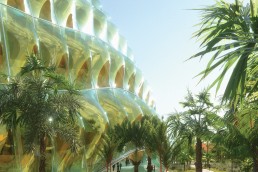
As the motif of the plant, I choose a lotus, one of a beautiful aquatic plant, and want to build an artificial lotus garden.
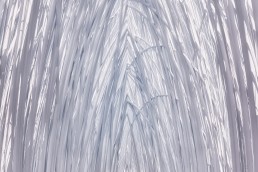
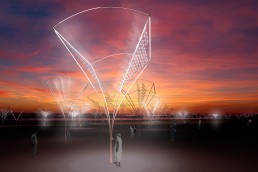
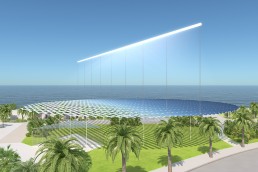
There are Organic Solar Cells on the surfaces of these lotus leaves, and they create electrical energy. Lotuses bend and wave in the wind. A stem of lotus keeps vertical. But when wind blows, it bends like a bamboo. TPE (Thermoplastic Elastomers) and stainless steel springs make this movement possible. The stems are hollow and house electrical wiring.
The leaves are also made of TPE, and water-proofed on the surface. They are as thin and as long as possible, and swing in wind and weight of rain. TPE is a recyclable and durable material that is fit for the harsh conditions of the site.

At the site under the water, lotus leaves float on the surface. These leaves don’t use stainless steel, and stand up via their buoyancy.

Organic Solar Cells are 1/10 the cost of common inorganic solar cells, require less embodied energy to produce and are non-toxic to the environment.

This lotus form has the merit in its construction: It doesn’t need to level without foundation, and it makes possible minimum ground level and maximum solar panel space.

An old Chinese proverb says “Lotus grows in the mud but never become muddy itself”. It is known as a symbol of virtue and pureness and is a suitable motif for a clean energy plant.

low-res version PDF of submitted boards

Tweet this!Tweet this!

Tags:

Fractal Generator

Tanzim Hasan Salim
Designed for Site #2 in Abu Dhabi, between Saadiyat Island and Yas Island.


Design Submission for the 2010 Land Art Generator Initiative Design Competition

Artist’s descriptive text:
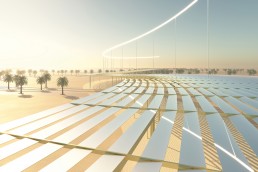
The inspiration from fractals is derived from concerns both aesthetic and pragmatic. Not only do they create interesting geometries and patterns, but they also give a practical advantage by increasing a surface area of a form.

Fractal geometry is a field that mixes art with mathematics to demonstrate that equations are more than just a collection of numbers. What makes fractals even more interesting is that they are the best existing mathematical descriptions of many natural forms, such as mountains, biological structures, and coastlines (such as that which runs along the site of the artwork). Using fractal geometries in the planning and organization not only generates more electricity than a non fractal linear arrangement but also become more contextual to the site.

The structural stiffness of the inclined structures supporting the photovoltaic panels can also be increased as the concrete pylons form together a type of folded-plate structure. As a whole the project represents nature’s microcosm at a human scale. It is a celebration of nature and technology.

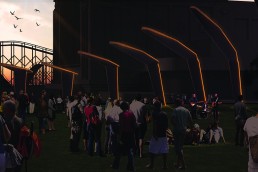
The pylons are oriented to maximize efficiency by properly adjusting each photovoltaic panel to an optimum angle & also by eliminating segments of concrete panels that fall into shadow zones. The total master plan would also incorporate fractals as pathways and landscaping elements.

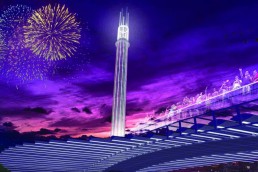
At night, these concrete inclined pylons become illuminated creating interesting silhouettes. These strokes of light are monumental as observers pass by the highways and stand as iconic art at a regional scale.

low-res version PDF of submitted boards

Tweet this!Tweet this!

Tags:

Solar Veil

Rudabeh Pakravan Studio
Rudabeh Pakravan, Juipai Chen, Victor Otter, Maya Taketani, and Sage Renewables
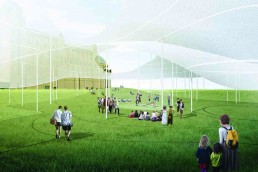
Designed for Site #3 in Abu Dhabi, on Airport Road near Masdar City.


Design Submission for the 2010 Land Art Generator Initiative Design Competition

Artist’s descriptive text:
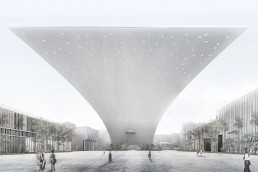
Living in the Middle East often involves negotiating the space between your body and the sun. Or between your body and the eye of a neighbor. The veil is a way for you to protect yourself from both of these gazes—a personal sanctuary in the form of a tent or a body covering. The veil itself is functional, but the space it creates within itself becomes infinitely valuable because it is covered.

Solar Veil capitalizes on the availability of a vast swath of land while consecrating it through the idea of the veil. By demarcating that which we consider sacred, whether it is land or body, we claim a responsibility for its cultivation and protection. Veils, curtains, and tents are also temporary; there is an acknowledgement of borrowed space, a desire to leave what we are covering unaltered underneath.

Our proposal covers the site at Airport Road with a porous drape of 300,000 solar units that together have a nameplate capacity of over 16MW of energy. At nearly 175,000 square feet, Solar Veil responds to both the scale of its context and its needs. It becomes a destination in its own right, becoming part of the history of record-breaking infrastructural endeavors in the region while reflecting the vastness of the landscape.

The drape lifts up and touches down on the ground, creating an occupiable and shaded public space. Slits are also cut into the drape and lifted up, catching wind in the direction of its flow and allowing air currents to enter and pass through the space. The wind catchers act in two ways as shown in the diagram above – one, to allow air to pass in and through the space and two, by connecting to an enclosed shaft that pushes the wind underground two meters, where the ground is a constant, cooler temperature. Air returns upward, cooling the space within the drape.

In a region where shaded public space is reserved for parks with entry fees, luxury malls, or on green patches alongside highways, our proposal will create a rare opportunity for people to participate in the public realm, either for recreation or to be a part of a social structure that supports environmental accountability. Situated immediately adjacent to Masdar, the world’s first carbon free city, Solar Veil can both take advantage of the physical infrastructure that is being built there, such as using the proposed monorail to access the site and limit the use of vehicular traffic, and the social network of a sustainable community.

Our proposal attempts to have minimum effect on the site at ground level. The ground remains 80% untouched, with the remaining 20% being excavated for shallow spread footings for the structural system and for the passive cooling tunnels. The site is mostly sparse, but porosity built into the drape system allows for light to reach some areas under the veil that would allow vegetation to remain. The ring of trees around the site remains untouched. At 600gm/square meter, the drape system is very light and needs only a minimal structural armature. We propose a light steel tube framing system that forms a lattice and columns. With the energy generation at a minimum of 16MW, Solar Veil can power 8,000 homes.

Solar panels have already proven to be an extremely effective source of renewable energy. It is no longer necessary to rely on the large and bulkier solar panels traditionally found on roofs or as part of solar farms, but even the most advanced solar cell technology that is available today relies on large, rigid backings and standard sizes to function. In order to create a drape, we are working with a thin film photovoltaic manufacturer to create a small scale unit that is made of photovoltaic laminates overlaid on a 7mm fiberglass panel. The units are 50cm x 50cm and link at the midpoint of each panel to provide flexibility. The units are incredibly light, allowing for attachment to a minimal structural armature. Our proposal ensures that the overall form of the veil allows for 60% of the units to be between 10 to 15 degrees from the horizontal, resulting in maximum solar contact.

Our proposal allows for 20% of energy generated to be stored for off peak use. Wanting a highly efficient storage system with a small footprint, we integrate a group of 12 sodium sulfur (NaS) batteries underneath the surface of the veil.

The surface area of Solar Veil is approximately 160,000 square meters. Even conservatively estimating that only 30% of its area is generating energy, Solar Veil can power 8,000 homes or other buildings in the community. At its peak, it can power twice that.

low-res version PDF of submitted boards

Tweet this!Tweet this!

Tags:

Sun Rite Gravitation

Maria Dundakova, Markus Walser, Dr. Heinrich Stülpnagel
Designed for Site #2 in Abu Dhabi, between Saadiyat Island and Yas Island.


Design Submission for the 2010 Land Art Generator Initiative Design Competition

Artist’s descriptive text:
Sun Panel Sculpture, Earth Sculpture, and the Tower
The language of nature is the language of people. Each kind of life (form) also has a (technical) function. The topography of Abu Dhabi is formed by the gravitational rhythm of the tide’s ebb and flow. Natural space and urban space are interconnected in a unique choreography of the elements earth, water, sun and air.

In Sun Rite Gravitation, a choreography of the tides emerges from the arabesque movements of the Earth Sculpture. Water channels that mark the Earth’s surface offer habitats for countless living species. Small, raised, dune-like formations provide a natural environment for green vegetation.

Among the elements that coexist with the natural tidal arena, the surrounding sun panels constitute a triangle that visually connects water and Earth. The sun panels rotate like sunflowers, tracking the sun.

Each individual element is just a piece of technology, but arranging them in a sequence creates a constantly changing line in the landscape that traces the horizon. A mirror on the back of each panel reflects the landscape, thus creating a dialogue between the sky and the Earth. The installation changes all the time, taking on a different aspect 365 days of the year.

A spiral-shaped tower connects sky and Earth and provides an opportunity for visitors to observe the entire surrounding landscape in all directions from above.
The chaos aesthetic of the macro and micro life elements and the juxtaposed new urban aesthetic of the sun panels have a mutually heightening effect.

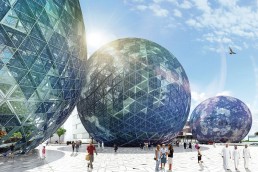
Three dialogue spheres, three sculptures, interact within a triangular topography. Each one is clearly and distinctly defined; aesthetic, economically sustainable functions hold them together and provide three supplementary rhythms.

low-res version PDF of submitted boards

Tweet this!Tweet this!

Tags:

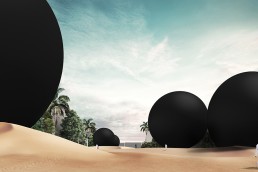
Mariyan Nasirpour and Behnaz Farahi Bouzanjani
Designed for Site #2 in Abu Dhabi, between Saadiyat Island and Yas Island.


Design Submission for the 2010 Land Art Generator Initiative Design Competition

Artist’s descriptive text:
The main concept of this project is “interactivity” with environmental parameters such as wind, solar energy, and water. The land is a transformative power of wind, sun and sea. In our estimation, interaction of this kind of projects with surrounding environment would provide a panoramic insight into sustainable future cities.

Site of this project is located on a stretch of waterfront off the road that connects Yas Island to Saadiyat Island. In a sense, any intervention in this area takes a considerable attention to the natural parameters.

Rarely a context has such dynamism and interaction between natural powers. Here should be a new concept of time, one that is ever‐changing as nature. An uncertain strategy (rather than a finished composition) that responds to its context by integrating and fusing with it. Intervention must only take place to simplify actual operation of wind, water and sun. As the result of this interaction, form and function will co‐evolve spontaneously resulting in mutable surfaces. This mutable surface will affect its immediate environment while it is affected by them.

As a context, nature has subjective boundaries. Where sea ends green starts and where green ends soil starts. Our land-based interventions take a variety of forms and motions and cover part of whole site in colored pinwheels.

This land art is composed of 20,000 colorful pinwheel modules containing motions (vertically and axially) and producing energy. In each moment in a day, according to the wind direction and its intensity, this land art transforms into a spectacle of dancing pinwheels and water. Moreover, during the day, it makes shadows underneath while converting wind power to electricity, cooling its immediate surroundings. At sunset, this work of art turns into a sparkling scenery of light, like a pinwheel galaxy.

As we consider function of this land art as a clean energy generator we take into account following parameters:

  • Wind flow direction changes between night and day where land meets water: Land heats up during the day more quickly than water, causing warmer and more buoyant air to rise. Cooler air over the water begins to push inland creating a breeze. The rising warm air over the land cools and moves over the sea to replace the cold air that moved inland. Land and water absorb and reflect solar energy differently due to their differing specific heat and reflectance characteristics. It takes far more energy to raise the temperature of a pound of water by one degree than a pound of earth. Landmasses typically reflect more of the sun’s energy while bodies of water tend to absorb more. This is illustrated by the fact that 12 to 30 percent reflectance is typical for meadows and fields, compared to 3 to 10 percent reflectance for water surfaces. The resulting temperature differentials ultimately lead to wind, clouds, and rain.
  • This project aimed to design a portable wind turbine capable of generating 6000 kWh per year in a nominally 15 mph wind. The design is a vertical axis wind turbine with two half‐cylinder blades and an interchangeable shaft to allow for a hand crank. The drive shaft powers a generator which stores electrical energy by charging a battery while a microcontroller monitors an ammeter to control RPMs. The product can power a communication device in remote areas or in power‐loss emergencies.
  • Surface of pinwheel is covered by Solar Ivy by SMIT. Solar Ivy is a solar energy‐generation and delivery system inspired by ivy. Solar Ivy’s unique visual appeal and flexibility brings a technology traditionally restricted to the any architectural surface. It has the ability to provide varying degrees of opacity to modulate heat gain, light transmission and view. In this project the leaves are made of 100% recyclable polyethylene and are available in a variety of colors and opacities which make the land art livelier. The Solar Ivy will increase the pinwheel surface friction in order to catch winds.
  • This pinwheel water pump reduces atmospheric air pressure inside the pump chamber. Atmospheric pressure extends down into the sea level channels, and forces water up the pipe into the pump to balance the reduced pressure.

low-res version PDF of submitted boards

Tweet this!Tweet this!

Tags: ,

Solar Organ

Bread LTD
Sarat Babu, Andrew Brand, Gianpaolo Fusari, Matt Johnson, and Nick Reddall
Designed for Site #2 in Abu Dhabi, between Saadiyat Island and Yas Island.


Design Submission for the 2010 Land Art Generator Initiative Design Competition

Artist’s descriptive text:
A transition from a world powered by fossil fuels to a world powered by renewable resources is built on two pillars, technology and culture. The technology must exist to harness the energy that is present in our environment, and culture must support the changes that our planet requires. BREAD proposes that the next step in this dual transition is to reach back into our cultural legacy to find a forgotten figurehead for technological and cultural progress, the organ. Powered only by the sun, using a technology known as thermoacoustics, the Solar Organ will produce both sound and electricity. Viewers will have a chance to walk within the organ’s structure, absorbed by the soft ethereal tones of this musical instrument, knowing that as it produces sound it is also feeding energy back into the grid. The goal of the installation is to demonstrate the energy present in the environment around us through an instrument that produces both beautiful music and electrical energy.

From Ctesibius of Alexandrea’s first organ in B.C. 2000 to Giacomo Antegnati’s organ in Milan’s Duomo, for almost 4000 years this instrument played the role of the technical avant-garde, funneling the world’s famous composers through networks of pipes and valves. Before the industrial revolution, organs represented global technical achievement. Capable of producing sound in a broader range than any other single instrument, the great wind organs had up to 10,000 pipes, some of which were 19 meters in length. An organ was a demonstration of a society’s technical prowess and commitment to culture. Today though, the wind organ has been replaced by contemporary electronics and is no longer the technical or aspirational figurehead that it was. In comparison to contemporary technologies, the organ is often seen as an antiquated instrument. Unfortunately this view misses the organ’s true beauty, the way in which it transforms energy into sound, and wind into emotion. This transformation is governed by the most basic physical laws of our world, giving the organ a beautiful simplicity.

Recapturing this elegance is essential when we look forward to future of energy resources. We must learn to capture the energy that exists around us rather than reaching into the ground. Global culture needs to change to appreciate the intelligence of satisfying our energy needs through wind, water and the sun. BREAD proposes the Solar Organ to act as a way to both reveal the untapped renewable energy present in the environment, and to act as an international platform for musical expression. The Solar Organ will be an installation that will allow contemporary composers and musicians to manipulate its mechanics, allowing the very movement of the sun to play their melodies. The organ will produce beautiful, clear, purely analog sound and electrical energy through the most renewable of resources, the sun. Rather than being played by a musician, the solar organ will be played by the sun itself. As the sun rises high in the sky its energy will be focused into the internal structures of the organ producing tones as ethereal and magical as the desert. As the sun moves across the sky, shadows created by active optics within the structure will control which tones are being generated so the presence of the organ will evolve throughout the day.

The Solar Organ’s primarily role is to change solar energy into sound and electricity. Known as a thermoacoustic hot air engine, the solar organ will transform the heat from the sun into a high-amplitude standing sound wave by creating a temperature differential within the device. The thermoacousitc engine is one of a family of “Stirling” type engines that transform ambient energy sources into work. The magic of these devices is that they capture and focus energy sources that exist slightly below our conscious perception, transforming them into active work that we can understand. The solar organ will demonstrate to viewers both the incredible amount of ambient energy present in the desert environment, and the potential for that energy to take many forms.

The Solar Organ has 27 distinct notes, each consisting of seven major components. A Fresnel lens, a switchable smart glass plate, a solar collector, a ceramic regenerator matrix, a metallised ceramic heatsink, a glass resonator, and a vibrating membrane for electrical power generation (linear alternator). Each of these units is self-contained. The tubes vary in length from 2.6 m to .669 m, the respective frequencies would be 65.41 Hz and 261.63 Hz, giving a potential energy output of 27 Megawatt hours per annum. The Solar Organ functions by absorbing heat from the sun, which heats the air within the unit, generating a standing sound wave. This sound wave will both create tones to be heard by viewers as well as powering a linear alternator which will generate electricity. The frequency (and thus the note) of the sound is controlled through manipulation of the physical characteristics of the resonator. The linear alternator is most basically a loudspeaker run in reverse. Instead of using a current to move the speaker cone back and forth (creating sound), the cone of the speaker is moved by the sound wave, generating electrical power.

As the Solar Organ requires time to absorb heat from the sun to create its tones, it cannot be “played” like a conventional organ. Rather, the solar organ can be programmed through control of the switchable smart glass. The smart glass can quickly shift between being opaque or transparent allowing for precise control over the solar load received by each unit, thus controlling the timing of notes and the creation of polyphonic chords. The programming includes relational timing between notes, but also absolute timing relative to the time of day. For example, the programming could be designed in such a way that the organ will only play at dawn or at dusk. Its malleable nature means that the solar organ will offer an increasable range of expression, all the while generating electricity to be fed back into the grid.

The Solar Organ will offer viewers two important experiences. First, it will enthral them with the soft but powerful tones of this large musical instrument. As they walk within the structure of the organ they will be left to wonder how such a simple device can create such incredible melodies using nothing other than sunshine. The second experience will be the realisation that by embracing the energy present in the world around us we can meet our needs and work within and alongside our environment rather than compromising it. Those who have walked through the site will leave with a glimpse of an energy future that works together with a changing culture to create elegant and beautiful solutions to our most pressing problems.

low-res version PDF of submitted boards

Tweet this!Tweet this!

Tags: ,

Sun and Water

David Tyl
Designed for Site #2 in Abu Dhabi, between Saadiyat Island and Yas Island.


Design Submission for the 2010 Land Art Generator Initiative Design Competition

Artist’s descriptive text:
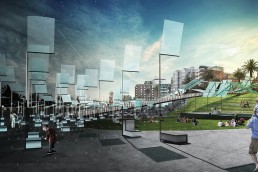
The following project is an essay on culture, combined with thoughts on progress and sustainability. It is meant both to interpret the landscape by connecting physical structure with natural environment, and to convey new ideas of sustainability and wonderment with regard to our current conception of energy generating devices. Primarily, it is meant as a sculptural device existing in the landscape, bridging the natural with the synthetic, the physical with the surreal, and expressing ideas of evolution, continuity, and the infinite cycle. It is also meant to stimulate thoughts on science, religion, and culture to all those who experience it.

The form of the structure is an investigation into interior spaces and privacy, leading to questions about the public realm and enlightenment. In skewing the boundaries between inside and outside spaces, the structure attempts to define what is meant to conceal, and what is meant to uncover. It brings about the notion of importance, and asks what becomes relevant to the argument; does one look to the outside from within, or vice versa? Where is the exterior, and to what are we to put focus on? Are we to attend to the natural landscape of the environment, or the speed and evolution of human progress? Where is the boundary?

In generating power, the structure makes use of two of the earths most abundant and renewable resources: water and sun. By using the two in a balanced manner, the idea is to create energy without the necessity for additional support in terms of non-renewable resources. By superheating the water that is local to the site (Site #2), by means of solar energy, there may exist enough energy and velocity to power turbines that will in turn generate useable power to the community. Solar power is thus used in two ways, that is, by way of directly heating the water that circulates through each ‘cube’ of the structure to create steam, and by way of photovoltaic panels that are attached to the grid portion of the structure – energy that is used primarily to assist in superheating the water to create steam. The result is clean useable energy that is created from merely water and sun.

Experiencing the structure is done in numerous ways; from a distance, within, and directly underneath. One may first come into contact with it visually from the sky (in an airplane), and again along the highway (in an automobile), and again within it walking among the ‘cubes’, and finally underneath it walking beneath the light emissive spiraled plane. The structure creates a visual impact both during the day and at night when it is lit. Low-energy electroluminescent lighting enables the structure to attract attention far and wide, creating a distinct image for the community that depicts sustainability, safety, power, and change. There is thus no time of day that the structure may not be experienced.

low-res version PDF of submitted boards

Tweet this!Tweet this!

Tags: ,

Sediment Spores

Kurt Franz and Come Menage
Designed for Site #3 in Abu Dhabi, on Airport Road near Masdar City.


Design Submission for the 2010 Land Art Generator Initiative Design Competition

Artist’s descriptive text:

“One of the inscriptions of time (whose irreversibility is demonstrated by the law of entropy), dust is, sociologically speaking, an index. Duchamp put his finger on this indexical quality quite precisely, when he let dust accumulate in layers of differing thicknesses (and thus different durations) on his Large Glass (1915-23) in order to obtain degrees of transparency and of varied colors once a fixative was applied. Elevage de poussiere(Dust Breeding) (1920), the photograph he had Man Ray take at this point…” -Rosalind E. Krauss

According to Georges Bataille entropy is, by definition, excess energy; an overproduction. The current world is heavily investing in renewable energy due to new laws, potential carbon taxes, etc., in which energy technological efficiencies will grow exponentially coinciding with Moore’s Law. If people are unable to control this growing energy production, the future will face the same problem we do today, excess energy we call waste and therefore the ability to store energy efficiently is more critical than producing clean energy itself.

Interestingly enough, Abu Dhabi finds itself at the center of this polemic being one of the worlds largest oil suppliers. This mass amount of stored energy has created a rapidly growing city and population that has produced excess tertiary space in its sprawl development. However, these spaces will eventually grow to the density of the city itself but it is uncertain the future energy that will facilitate such growth knowing that oil wells will inevitably run out. Many nations have been investing in their underground salt mines to store energy in the highly efficient form of compressed air. Why could not Abu Dhabi do the same with their oil wells, augmenting space devoid of its original use?

Sediment Spores puts into place a similar initiative by using devoid space and excess materials and matter from city growth to create bulbous caverns of compressed air energy storage/solar energy production land art piece on Site 3. The interest of entropy, waste and excess was derived from the context of the site, energy production, and past land artists such as Robert Smithson and conceptual artist Marcel Duchamp. The site itself is a leftover space that is blocked from view by foliage. Such places are only noticed, or not noticed, once created. That is to say, “we only see the dust once it has settled.” The site is situated between 3 freeways near the airport and seemed to have the least value of the three sites thus proving the most potential.

The project addresses the “structural blindness”, as Smithson puts it, of waste in the building process. By using excavated soil from building(waste) as an instrument and a particular sand calcifying bacteria behavior as an architecture, the proposal intends to challenge viewers perception of how space in a rapidly growing city is created and understood by creating new material structures with waste by looking at systems of nature. This is not to battle entropy but on the contrary, to embrace it showing it’s repressed potentials in an urban context.

The forms of the Sediment Spores are derived from the behaviors of its constructors. A study of Bacillus pasteurii movements and actions(a sand calcifying bacteria that is able to turn sand into solid stone in a 24 hour period) created emergent forms from our Java based 3D algorithmic visual script. The resulting forms are scaled up and placed onsite to accommodate the proper amount of energy storage to serve a large enough audience as well as the amount of incoming excavated building soil from development growth.

Excavated soil from building development as well as the increase of sewage systems necessary both contribute to Sediment Spores production. By placing sand molds created from the emergent forms on Site 3, dumping excavated soil in them and adding calcifying bacteria with urine(urea is a key component of urine and is a key component in the bacteria’s calcifying process) the project parallels the process of Large Glass but on the scale of the city. When the city grows so does our project. The resulting complex and organic patterning allows for multiple spatial features, incremental growth with the Abu Dhabi’s development, and different animal habitats which allowing for public viewing and interaction while performing as a solar energy harvesting and compressed air energy storage for thousands of homes.

The project Sediment Spores proposes a new layering of soil in the AUE’s rich geographical setting. Like Duchamp and Smithson, the project takes the waste of a fast growing city (the newest geological layer) and uses its inherent characteristics of it creating an unique solar production landscape of compressed air energy storage and art. Additionally, the project speaks about today’s use of technology and energy in the everyday and in the art and design process by using Java based algorithmic scripting as a new drawing tool to generate multiple forms and solutions. The site specific project draws connections between past energy uses, contemporary building growth and future energy practice in order to augment the viewers thought about their everyday environment by revealing nature, growth, and energy in a different way.

low-res version PDF of submitted boards

Tweet this!Tweet this!

Tags: ,

Michael Jantzen
Designed for Site #2 in Abu Dhabi, between Saadiyat Island and Yas Island.


Design Submission for the 2010 Land Art Generator Initiative Design Competition

Artist’s descriptive text:
My design inspiration for site number two comes from a conceptual symbolic representation of the micro energetic interaction between photons of sunlight, and the release of electrons within photovoltaic cells, which in turn form electricity. This energetic interaction is symbolically represented for this competition as a large, pragmatic, scalable, abstract, three dimensional, stimulating and challenging form, capable of capturing energy from the sun, and converting it into electricity for the local community.

The basic structure would be constructed from a series of prefabricated panels, each fitted with a steel support frame, and covered with a colored concrete composite skin. These panels can be added or subtracted in order to scale the structure up or down and/or to change the shape at any time.

Minimal negative environmental impact is anticipated with this design because of the small amount of structure actually touching the ground. Also a minimal amount of foundation should be required with most of the land under the structure left open for human and animal passage.

An appropriate number of the south-facing panels would be covered with shadow tolerant, non-glass, high temperature performance photovoltaic film made by the Uni-Solar company. All of these panels are placed high enough on the structure so the visitors cannot reach them. In full sunlight with full exposure, the solar panels could generate approximately ten thousand watts of electrical energy for the local grid. I chose to harness energy from the sun with my structure since the sun is the most abundant form of alternative energy at the site, and is certainly symbolic of the desert environment in which the Solar Energy Field would be placed.

I think that those who visit the structure would see it as an amazing apparition or mirage in the desert that would soon become a world-known tourist destination. In addition, it would function as an oasis sheltering the visitors from the hot sun. Some of the lower panels of the structure fold out in different ways in order to provide places to sit or lie. There is also a stairs (leading to a viewing platform) built in under the structure so people can actually climb up into the Solar Energy Field for a better view of it and the surrounding landscape.

Two of the panels that form the structure fold out in different direction along the ground and become pathways leading visitors to and from the Solar Energy Field with access off of the main highway that connects Yas Island to Saadiyat Island.

low-res version PDF of submitted boards

Tweet this!Tweet this!

Tags: ,

Solar Biennale

Ross Hamilton
Designed for Site #1 in Dubai, near Ras al Khor Wildlife Sanctuary.


Design Submission for the 2010 Land Art Generator Initiative Design Competition

Artist’s descriptive text:
Dubai owes much of its current success to the discovery of oil offshore in the late 1960’s. A spike in oil prices during the 1970’s was the spark that ignited Dubai’s economic boom. Today, global oil consumption has risen steadily as more and more people gain access to new technologies. Developing countries are becoming industrialized and are demanding their share of the global oil reserves, while long time users are increasing their demands daily. Because of this the world’s oil reserves are being depleted at a fantastic rate. It is believed that peak oil production will occur in 2020. From this point on, oil production will steadily decline; and oil consumption must eventually do the same.

Dubai is already turning the focus away from its oil history and toward its global future. Oil now accounts for only 6% of its total revenue. Dubai’s desire for a global presence has been the cause for an almost manic development. A desert oasis has grown out of nothing to host some of the world’s most astounding monuments and most advanced technological achievements. Designed as a tourist destination, Dubai has no problem drawing people in, but there is still a missing sense of legitimacy. The U.A.E. is becoming an arts and culture center through the use of boutique museums and cultural icons.

This is Dubai’s opportunity to create a new arts center just outside the city. Following the model of the Venice Biennale, this project proposes a biennial exhibition be created in Dubai. However, this exhibition will not be a limited participation biennale that is overly focused on western culture, but an open art exhibition where global artists can be exhibited and discovered. Artists are beginning to test the different ways in which art can be defined and because of this, new forms of art are emerging. These exhibition spaces will be set up to display new forms of multimedia art and solar art rather than traditional forms. There is an overall rethinking of the relationship between art and energy taking place, and this is the moment when a Solar Biennale would be a welcome addition.

This proposal implements a system of nodes derived from a mapping of the top 100 oil consuming countries in the world. This map will provide a basis for both the biennial pavilions at ground level, and the solar canopy that powers the spaces. The ground-level pavilions will compose the Solar Biennale, and will serve to house the multimedia presentations on the site. The overhead solar canopy will provide shade for the pavilions and event spaces while producing energy to be redistributed to the grid or used on-site. The pavilions and installations will be able to plug directly into the surface for power. The surface will be composed of four different types of solar panels: a “traditional” blue solar panel, opaque and monolithic; red solar film, transparent and flexible; grey solar fabric, opaque and flexible; and light blue solar units, transparent and modular.

Over time, as the oil use throughout the world changes, the map will have to be redrawn. As the world oil supply begins to dwindle; alternative fuels will become more common, and countries will begin to move away from the use of crude oil. The solar network that exists on the site will shrink gradually as oil consumption is reduced. This will invest the site with a sense of dynamism which will encourage people to come visit again and again as time passes, especially as oil use nears zero. When oil consumption finally dwindles to zero and the last solar panel is removed from the site, the world will celebrate its long awaited freedom from oil. With the removal of the last pavilion, media art is fully integrated into society, and the next land-art generator initiative is born.

low-res version PDF of submitted boards

Tweet this!Tweet this!

Tags: ,

« Older entries § Newer entries »