Solar

You are currently browsing articles tagged Solar.

project s: flow

Joanna Wlaszyn, Qian Xu, and David Verrier
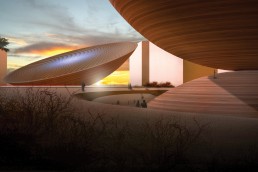
Designed for Site #2 in Abu Dhabi, between Saadiyat Island and Yas Island.

Joanna Wlaszyn is an independent architect, designer and researcher living and working in Paris.


Design Submission for the 2010 Land Art Generator Initiative Design Competition

Artist’s descriptive text:
IDEA
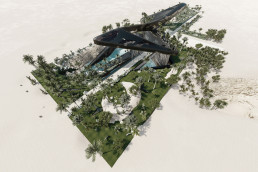
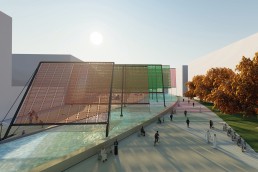
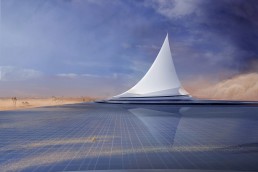
The s: flow project is an active land art installation which creates a flow of visible interactions between environment, technology and phenomena of sunlight reflections. At the same time the installation questions the visual dimension of distance and length perception. s: means here: sun, sunlight, solar, sunshade, see, sky and sand. While moving along the installation, the sun reflections on the glass continuously change and create the flow of sunlight motion. Each time of the day the installation takes a whole new appearance in a permanent dialogue between light and shadow, nature and technology, and especially between man and his environment. This dialogue can be only completed by the viewers – in the way that the viewer becomes an integral part of the installation. The volume of the project is more or less visible and imposing according to the sun movement. Such a perceptual discharge of the environment is accentuated by the contrast between the blueness of the sky and the reflective sand. s: flow composes a harmony with the environment and provides a path to be followed like an invitation to the silent walk in this environment almost empty and mostly devoid of vegetation.

DESIGN CONCEPT
The shape of the installation is a simple deformation of a straight line into a spline. The spline follows the natural shape of the area’s edge: the borderline between sea and land. The form of s: flow is composed of a reflective glass which provides a vast surface for solar energy. By using material properties of glass like reflecting sunlight spectrum s: flow becomes a source of solar energy production. To keep a good transparent effect of glass, the structure of installation is made of a light supporting metal load-bearing structure as a reliable system. This construction material adopts recycle and environment protection materials. Energy captured from sunlight and its reflections on sand is transformed into electrical power by Spherical Micro Solar Cells: Sphelar. Sphelar cells optimize the use of reflected and indirect light. There is no hidden side : both sides generate electricity wherever the light source is located. Sphelar provides up to 80% high transparency possibility. Actuating cables placed in the metal structure transmit the energy to be transformed into electrical power through the grid connection cables placed in the ground. To respect the existing natural condition, the boundaries between public and restricted areas will be indicated by the invisible sound alarm system placed on the ground. The only platform to visit the installation is made by the footprints of the visitors and by the consideration of their sensibility to surroundings protection.

low-res version PDF of submitted boards

Tweet this!Tweet this!

Tags:

Predock Frane Architects:
Hadrian Predock, John Frane, Principals
Chris Schoeneck, Johanna Beuscher, Heinrich Huber, Design Team

Designed for Site #3 in Abu Dhabi, near Masdar City.


Design Submission for the 2010 Land Art Generator Initiative Design Competition
Third Place Mention from the Jury

Artist’s descriptive text:
SOLARIS – Predock + Frane

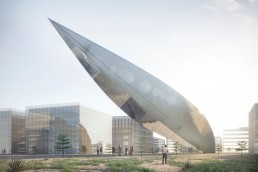
Critically engaging the emerging Abu Dhabi context of Masdar City, Zayed University and other tabula rasa territories, our project proposes an antidote and refuge to the frenetic future-scape internationalism of the rapidly developing Arabian coast. In proposing a new abstract art space that allows for escape and contemplation our project positions itself as a hybrid landscape/environmental machine that can both deliver power and engage the radical phenomenon of the desert. Along a path connecting Masdar City to Zayed University, a low-slung, energy producing sensitive field beckons public engagement.

Our proposal for the Land Art Generator Initiative on the Masdar adjacent site is conceived as a sensitive draping tissue whose shape responds to the local natural forces of the Arabian Desert, while simultaneously acting as a phenomenological instrument that engages and reveals the power and subtlety of desert light and surface. Like the woven hair of a Bedouin “black tent”, a field of intelligent solar modules form a veil that covers the entire site. Sometimes acting as landscape, sometimes as spatial enclosure, the solar units undulate across the site forming a deeply considered pattern of responses to wind, sun, night sky and pathways. Mirroring the blanket of reflective modules, the geometrically patterned ground plane of sand and water further defines the site and engages in specific environmental response.

Seeking analogs specific to the Arabian Desert, our project conceptually weaves together behavioral traits of the desert ecology into our designed fabric. Research into both the human constructed and the naturally occuring yields a wide and deep field of understanding. The nomadic Bedouins (who perceive themselves as the original Arab tent dwellers) have an intimate relationship with both the landscape and their herds of goats. Like a magic carpet, their performative tent dwellings are highly responsive and adaptive to the desert extremities. Made from the hair of their sustenance, the black matted surfaces of their tents act as environmental modulators. Under different climatic conditions, the porosity of the woven hair either opens or closes. In the desert landscape, the formation of dunes demonstrates a “power by numbers” dance between particles of sand and wind where accumulated quantity achieves an overall coherent quality. The dunes are dynamic organisms that never have a fixed form and travel in packs as mobile landscapes.

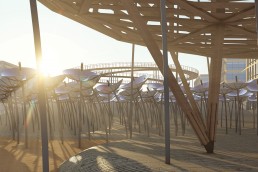
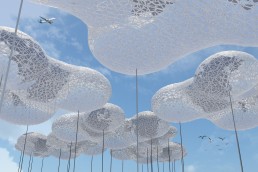
Our project behaves in ways similar to both the Bedouin tent and the sand dune, actively deploying a simple module (Cool Earth solar balloon) in quantities that allow for a range of specific behaviors. As an analogous “black tent” operating on an enormous scale, our proposal finds its morphology by synthesizing together both energy optimization, environmental behaviors and atmospheric effects. Beginning with a field of Cool Earth inflatable solar units on a grid oriented to the ideal solar angle (South), the basic carpet of modules is pulled off the ground to a crescendo in the middle of the site targeting on the North Star – Polaris, the ultimate point of orientation within a landscape free of points of reference. Developing localized environmental responses, the field of solar units densifies in areas to keep Summer sun out while creating a more porous pattern where Southern Winter sun is allowed to penetrate the interior. Winds – both good and bad – are mitigated as well. The Shamal brings dry wind that lasts the year round and supplies a powerful cooling agent when funneled correctly. This wind conditions the Northwestern side of the project forming an undulating edge that directs air across shallow pools of groundwater toward the interior realm. The Sharqi, which is a hot humid Summer wind, is blocked along the Southeastern edge of the site with shaped sand acting as a land barrier and deflector. These responses in coordination with each other form a sensitive, responsive tissue.

Phenomenologically, the project seeks a larger engagement with time, revealing and engaging light and matter – a sensate realm where one is allowed to simply feel and experience the slowness and power of the desert. In this regard, the field of modules acts as a surrogate reflective sky with heightened adjustments toward specific views. It also creates a pattern of dappled light that emanates from the environmentally induced responses. The underside of the solar modules are a reflective black sheen that mirrors the surface of the patterned ground matrix of water and sand, drawing heat up and out of the interior volume.

A tunneling path that stems from vital transportation hubs, links Masdar City across our site to Zayed University. Entering from Masdar, one descends into the ground within an orchard of date palms, tunnels through the earth inside a ribbed body, and emerges within the abstracted interior volume. The ground plane is a geometricized patchwork of sculpted dunes and excavated pools of groundwater. The sand of the ground is evenly cut and filled throughout the site, creating a large berm along the Southeast edge combating the harsh Sharqi wind. This artificially natural groundscape merges with the canopy of solar modules along the perimeter of the site forming a unified solar landscape.

Power Generation

Working collaboratively with Cool Earth, producers of a new breed of high concentration solar modules, our project deploys an ingenious new breed of solar technology. Eliminating the metal content and material weight of traditional flat solar panels with air and recyclable plastics, the Cool Earth module takes into consideration the Cradle to Cradle carbon footprint thinking of the entire lifecycle. Using inexpensive and free materials, the balloon-like solar unit makes cost and efficiency its modus operandi. A curved, mirrored, mylar surface is designed to concentrate the sun’s rays of energy onto a cell of highly efficient photovoltaic material. The concentrated cell produces around 300-400 times the energy than that of a conventional cell. With close to 25,000 solar cells the Solar Canopy will produce on average 73,000 megawatt-hours per year – enough to power the country of Chad for a year. The soft curvaceous underbelly of the combined units makes for a sensuous undulating surface that contains the indoor-outdoor spaces below. Structurally, a mast and cable system like a tent will create a tensile cable net that the solar units are suspended within. Like a field of sunflowers the Cool Earth units will track the sun angle, optimizing energy gain.

While the power generation is largely to benefit that which exists beyond our site, part of the energy produced is reserved for the benefit of the artwork. Hardworking and absorptive during the day, at night, a slow and unfolding wash of delicate colored light contrasts with the starry heavens across the canopy underside.

low-res version PDF of submitted boards

Tweet this!Tweet this!

Tags: ,

NanosolarCellWhitePaper

Nanosolar has announced the release to the market of its ultra-low cost (CIGS printed on aluminum foil back-contacted with metal-wrap-through design) nanoparticle ink flexible solar panels. A PDF of the details from the company can be downloaded here. This could be a real breakthrough in efficiency and affordability of CIGS (copper indium gallium selenide) technology. It is less energy intensive than silicon-based technologies in its production and achieves greater efficiencies in the field as high as 21% (the latest panels from nanosolar are only at 12% total panel efficiency, but the cost per square meter is significantly lower which is the major breakthrough).

How sustainable are the resources that go into CIGS?

Copper:

As with many natural resources, total amount of copper on Earth is vast (around 1014 tons just in the top kilometer of Earth’s crust, or about 5 million years worth at the current rate of extraction). However, only a tiny fraction of these reserves is economically viable, given present-day prices and technologies. Various estimates of existing copper reserves available for mining vary from 25 years to 60 years, depending on core assumptions such as the growth rate.

Indium:

Up until 1924, there was only about a gram of isolated indium on the planet. Indium is produced mainly from residues generated during zinc ore processing but is also found in iron, lead, and copper ores. Based on content of indium in zinc ore stocks, there is a worldwide reserve base of approximately 6,000 tonnes of economically-viable indium. This figure has led to estimates suggesting that, at current consumption rates, there is only 13 years’ supply of indium left. However, the Indium Corporation, the largest processor of indium, claims that, on the basis of increasing recovery yields during extraction, recovery from a wider range of base metals (including tin, copper and other polymetallic deposits) and new mining investments, the long-term supply of indium is sustainable, reliable and sufficient to meet increasing future demands. This conclusion also seems reasonable in light of the fact that silver, three times less abundant than Indium in the earths crust, is currently mined at approximately 18,300 tonnes per annum, which is 40 times greater than current indium mining rates.

Gallium:

Gallium does not exist in free form in nature, and the few high-gallium minerals such as gallite (CuGaS2) are too rare to serve as a primary source of the element or its compounds. Its abundance in the Earth’s crust is approximately 16.9 ppm. Gallium is found and extracted as a trace component in bauxite and to a small extent from sphalerite. The United States Geological Survey (USGS) estimates gallium reserves to exceed 1 million tonnes, based on 50 ppm by weight concentration in known reserves of bauxite and zinc ores. Some flue dusts from burning coal have been shown to contain small quantities of gallium, typically less than 1% by weight.

Selenium:

The reserve base for selenium is based on identified copper deposits. Coal generally contains between 0.5 and 12 parts per million of selenium, or about 80 to 90 times the average for copper deposits. The recovery of selenium from coal, although technically feasible, does not appear likely in the foreseeable future. An assessment of U.S. copper resources indicated that total copper resources in identified and undiscovered resources totals about 550 million metric tons, almost eight times the estimated U.S. copper reserve base.

Assuming that sustainable extraction and refining processes are set in place it seems that there is enough of the raw materials to continue to supply CIGS panels for the near term but probably not in the abundance necessary to replace any real significant amount of fossil-fuel-combustion energy production. It’s hard to say from the numbers and I’m not sure how much goes into each square meter of nano-technology based panel production. The “ink” is probably very thin.

But questions of sustainability aside, what is the most amazing part of the advancements in nanoparticle photovoltaic technology from the standpoint of its application to Land Art projects is the ability for the surfaces to be three-dimensionally applied and configured. One can easily imagine endless variations of sculptural forms with the surfaces feeding solar energy into a grid of collectors.

Jean_Arp_Solarcieux2
Jean_Arp_Solarcieux
A re-working of Jean Arp’s 1942 Silencieux that I have dubbed Solarcieux

Tweet this!Tweet this!

Tags: ,

800px-Suntower

I’ve stumbled across a number of articles recently that seriously propose that we set up huge solar arrays in space and wirelessly beam kilowatts back to earth such as this one highlighting the plans being discussed in Japan. The originators these plans are very legitimate and there is even an international conference being held right now on the subject in Ontario. The subject has its own advocacy blog. Then there is the National Space Society version. NASA is working on it. MIT is working on it:

Space solar power stations are envisioned as large solar power collectors in geosynchronous earth orbit. Solar energy would be gathered by photovoltaic cells and converted to microwaves so that it can be beamed wirelessly to receivers on earth. Space solar power is clean, inexhaustible, available 24 hours a day, and has the potential to generate as much energy as terrestrial power plants.

If the orbit is geosynchronous though, wouldn’t it be in the shadow of the earth for at least 8 hours per day? I suppose that the further away from the earth it is placed in orbit, the longer the sunlight would strike its surfaces, but it also seems that the limiting technological factor of the beaming of microwaves from the satellite to the surface of the earth would also require that the orbit be as low as possible.

The idea is tempting since the available energy outside of the atmosphere is 136% that available on the surface due to the reflective effect of the atmosphere itself. The surface are required to fuel the world with solar would therefore be 74% of that required on a land-based installation.

warmingeffect

And what about the arrows in this diagram that are bouncing back into space? Don’t we want that to continue to be the case? All things equal, wouldn’t it be adding to the overall amount of heat energy on the planet to harness more Joules of solar radiation than would naturally be absorbed by dark soils and plants down below? The law of conservation of energy tells me that bringing more sun energy into the atmosphere than would naturally be absorbed is not necessarily a good idea. Sure the energy is immediately captured as electricity and then sent to run kinetic devices, but the running of those devices creates heat and that heat is then a part of our inner atmosphere. Multiplying this continuously over many years and the effect may add up.

I don’t claim to know the answer to this, but I’m a bit of a precautionary person when it comes to messing with the natural order of things. Maybe it is better to stay down on the beautiful surface of the planet where we naturally are comfortable and to figure out solutions to our problems that are based on earth rather than out in space.

Tweet this!Tweet this!

Tags: , ,

Solar Roads

Highways

Two weeks ago it was announced that Solar Roadways received a $100,000 grant from the US DOT to prototype their idea for a “decentralized, secure, intelligent, self-healing power grid” that would “end dependence on fossil fuels and revitalize the economy”. I first saw it here on inhabitat.

Solar Roadway

This follows on many other road-related energy generating ideas for the unused right-of-way areas on the sides and medians of roads. These include the Green Roadways Project, ideas for micro-generation turbines in jersey barriers, and state-financed linear solar farms along highways. There are even prototypes being built with piezoelectric energy harvesting devices embedded in the road surface itself.

These are all fascinating ideas. Hopefully as we progress from the research and development phase and into the prototype and commercial viability phases, there is also a level of thought around aesthetics and the usefulness beyond the level of utility of what are sure to be extremely visible installations that will be passed by millions of drivers on a daily basis. I’m sure that integration with billboards and other advertising media will be in the works as these turbines and linear solar farms begin to make a more ubiquitous appearance on the periphery our highways.

As for the actual road surfaces providing a continuous smart grid, the Solar Roadways version is intriguing but I wonder if there would be a way to embed a more nano-scale technology into a surface that is pour-able and plastically mend-able rather than one that is more macro-mechanical and panelized. I’m sure that the inventors are working on the material properties and stability but the heaving of the freeze-thaw cycle in northern climates will surely be of grave concern to such rigid modules.

The potential to have vehicles that are constantly powered off of such a road system is of course the next step in the enticing arc of this narrative. The transition to this would be probably in phases, the first of which would be powering stations that are fed from the solar-road grid. The next would be to transfer the energy on the fly. A system being developed in Korea would embed the hardware for such a transfer in the road surface.

Another idea would be to use the recently resurgent ideas of wireless energy transfer to provide a field of energy through which vehicles would pass. The devices that would generate this energy field would be placed at the shoulder of the roadway at sufficient intervals. Hopefully such devices would be designed to be appealing to the eye. They could even have the added benefit of acting as noise canceling devices by sending out inverted sound waves of the real-time noise emitted from the passing traffic.

Tweet this!Tweet this!

Tags: ,


click for larger image

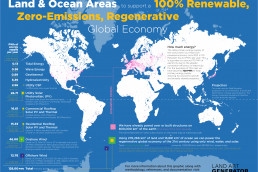
According to the US Department of Energy (Energy Information Administration), the world consumption of energy in all of its forms (barrels of petroleum, cubic meters of natural gas, watts of hydro power, etc.) is projected to reach 678 quadrillion Btu (or 7.15 exajoules) by 2030 – a 44% increase over 2008 levels (levels for 1980 were 283 quadrillion Btu and we stand at around 500 quadrillion Btu today).

I wonder what surface area would be required and what type of infrastructural investment would be required to supply that amount of power by using only solar panels. To create fuel that can be used in vehicles and equipment I am assuming that some of the electricity generated would be used to create hydrogen. We should all start wondering about these things since we will have really no other choice* by the turn of the next century.

So to find this out we start with the big number 678,000,000,000,000,000 Btu.

Converting this to KW•h [1 Btu = .0002931 kW•h (kilowatt hours)] makes 198,721,800,000,000 kW•h (199,721 TW•h). This is for an entire year. As a comparison, the average household uses approximately 18,000 kW•h per year (1/11 billion of the total world usage).

We can figure a capacity of .2KW per SM of land (an efficiency of 20% of the 1000 watts that strikes the surface in each SM of land).

So now we know the capacity of each square meter and what our goal is. We have our capacity in KW so in order to figure out how much area we’ll need, we have to multiply it by the number of hours that we can expect each of those square meters of photovoltaic panel to be outputting the .2KW capacity (kilowatts x hours = kW•h).

Using 70% as the average sunshine days per year (large parts of the world like upper Africa and the Arabian peninsula see 90-95% – so this number is more than fair), we can say that there will be 250 sun days per year at 8 hours of daylight on average. That’s 2,000 hours per year of direct sunlight.

Therefore, we can multiply each square meter by 2,000 to arrive at a yearly kW•h capacity per square meter of 400 kW•h.

Dividing the global yearly demand by 400 kW•h per square meter (198,721,800,000,000 / 400) and we arrive at 496,804,500,000 square meters or 496,805 square kilometers (191,817 square miles) as the area required to power the world with solar panels. This is roughly equal to the area of Spain. At first that sounds like a lot and it is. But we should put this in perspective.

If divided into 5,000 super-site installations around the world (average of 25 per country), it would measure less than 10km a side for each. The UAE has plans to construct 1,500MW of capacity by 2020 which will require a space of 3 km per side. If the UAE constructed the other 7 km per side of that area, it would be able to power itself as a nation completely with solar energy. The USA would require a much larger area and approximately 1,000 of these super-sites.

According to the United Nations 170,000 square kilometers of forest is destroyed each year. If we constructed solar farms at the same rate, we would be finished in 3 years.

There are 1.2 million square kilometers of farmland in China. This is 2 1/2 times the area of solar farm required to power the world in 2030.

Compare it to the Saharan Desert:

The Saharan Desert is 9,064,958 square kilometers, or 18 times the total required area to fuel the world.

By another measure, “the unpopulated area of the Sahara desert is over 9 million km², which if covered with solar panels would provide 630 terawatts total power. The Earth’s current energy consumption rate is around 13.5 TW at any given moment (including oil, gas, coal, nuclear, and hydroelectric).” This measure arrives at a multiplier of 46 times the area needed and shows that my numbers are very conservative.

Compare it to highways:

At a density ratio of 800km per 1000 square kilometers and a total length of 75,440km, the overall area of the US interstate highway system (constructed entirely between 1956 and 1991 – 35 years) is 94,000 square kilometers, or 20% of the overall required area for the world. The US also consumes about 20% of the world’s energy. (if the efficiency of conversion from solar to electricity was 100%, the area of USA highway would be equal to exactly that required to run the world). Indeed if every nation were to embark on a state program of the scale of the US highway system we could be finished with the required infrastructure in 20-40 years.

Compare it to golf courses:

The typical golf course covers about a square kilometer. We have 40,000 of them around the world being meticulously maintained. If the same could be said for solar farms we would be almost 10% of the way there.

Also remember that we are working here with a worst case scenario based on projections for the year 2030 that assume a lot about growth. What could we do to lower the overall Btu load? And what other sources of clean energy could contribute to lower the area needed for solar panels?

Wave:

World wave energy potential = 2,100,000,000,000 KW•h (2,100 TW•h) or 1% of the required load.

Wind:

A 5 MW turbine can be expected to produce 17 GWh per year (they are 40% effective from their peak rated capacity – 5 MW x 365 x 24 = 43.8 GWh). Therefore, it would require 11,748,294 of the 5 MW capacity turbines to create the same yearly output. There are 500 million cars in the world so it’s not like that’s an unattainable goal from a manufacturing standpoint. And each 5 MW turbine is a 30 year lifespan money making machine for whoever buys it. The same can not be said for my car. But if we can build 90,000 Cape Wind size installations, we would be there on wind alone. Based on that installation, each turbine requires 1/2 square mile of area for offshore sites. This would require 5.85 million square kilometers for 2030 world energy needs.

Here is a graphic for wind based on the notes above. The area in the North Sea is taken directly from the OMA proposal by Rem Koolhaas the pdf of which can be seen here.


click for larger image

Existing Hydroelectric:

I say existing hydroelectric because it would be damaging to the environment to construct more dams on rivers. Such designs have been shown conclusively to have a deleterious effects on the ecosystems of the watersheds that are fed by the existing river.

As of 2004, hydroelectric power accounted for 6% of the energy production in the world. A conversion of this percentage into energy capacity makes 28 quadrillion Btu (492 quadrillion Btu x 6%). As a percentage of 2030 levels and accounting, this would be more like 4% and accounting for a hopeful decommissioning of existing dams, let’s assume 2%.

So these other sources together have the potential to reduce the area required by 5% – 25% based on the amount of wind power we tap into. Solar panels are really going to have to do the vast majority of the work but a sustainable solution is going to require a great mix of solutions that are diversified as much as possible.

The technologies are improving and the efficiencies are getting greater. We must make it our goal to by the end of this century construct the area required by at the same time reducing our demand and by starting the necessary infrastructure projects today everywhere around the world. Otherwise the consequences are unthinkable.

*As for nuclear power, it currently produces 2.5% of the world’s energy or 10 quadrillion Btu per year. In 2008, the International Atomic Energy Agency (IAEA) predicted that nuclear power capacity could double by 2030, though that would not be enough to increase nuclear’s share of electricity generation. As for the non-renewable resource of uranium, according to the nuclear industry’s own estimation:

Current usage is about 65,000 tU/yr. Thus the world’s present measured resources of uranium (5.5 Mt) in the cost category somewhat below present spot prices and used only in conventional reactors, are enough to last for over 80 years.

80 years does not equal sustainable. And this is only assuming current use rates (the 5% of world energy needs).

An average plant puts out 3 cubic meters of spent fuel each year. Assuming 1000 plants operating around the world (there are 500 today), that would makes 3,000 cubic meters per year. Over those 80 years this would create a volume of 240,000 cubic meters or a cube of 60 meters on each side (bigger than the Pantheon and roughly equivalent to the volume of the Gol Gumbaz Mausoleum. What do we do with that amount of dangerous radioactive material that has a half life of 2 million years?

Update 1: some comments being posted here:
reddit
digg

Update 2: Many comments have to do with the distribution of energy. I reiterate that I am in favor of a maximizing of diversity of clean energy technologies and of points of generation. For example, if we use the figure of 6 billion people in the world, and if over the course of each person’s lifetime they would be responsible for creating a panel to use their equal share of the worldwide demand (never mind the non-equal distribution) then we would each be in for a 9m x 9m square, or something that gives off 33,000 kW•h per year. With a typical home roof installation that assumes 15 kW capacity. Obviously this extreme localization is also not ideal — what is needed is a plan that captures the best balance of centralized/localized and best mix of renewable and clean resources.

Update 3: SES technology would bring down the solar area required to 315,000 square kilometers (based on the 629 kW•h per square meter listed on the site sourced as from Southern California Edison and Sandia National Laboratories). This is a 40% reduction just on efficiency of the capturing device. The technology will continue to get better and better…

Tweet this!Tweet this!

Tags: , , , ,

Gizmag features an article on the Almeisan Tower here.

My original post on the project.

Update on Tuesday, July 14: Many other blogs have picked up on the project such as inhabitat, greendiary, and ecofriend. Thanks to all.

Tweet this!Tweet this!

Tags: ,

nanoantennas

If this technology ever makes it into commercial production then it will open up a huge potential for creative uses.

Tweet this!Tweet this!

Tags: , ,

Solar Ivy


We would love to be able to create an entire orchard from the amazing solar ivy PV cells by SMIT. They combine solar generation with piezoelectric generators that create additional energy from the movement of the leaves in the wind:


Discovered via inhabitat


I have long thought about how beautiful an orchard of 100 (10×10) trees with PV leaves would be. The most beautiful place I can imagine to sit and contemplate is on the grass in the middle of an orchard. The sun makes such a beautiful tapestry of shadow on the ground and the multi-point perspective that the grid of trees constructs is ever-changing as you walk within. My personal favorite is an olive tree orchard with its tiny silvery leaves. Just imagine sitting in the midst of all that beauty while knowing that it is generating electricity. I figure an orchard that size would be enough to run more than a dozen homes. The above sketch is from an olive orchard on the Northern outskirts of Florence.

Tweet this!Tweet this!

Tags: , ,


Concentrated photovoltaic (CPV or HPVC) technology concentrates sunlight through a lens onto a high performance solar cell, thus increasing the electricity generated over conventional PV panels. Typical photovoltaic panels only convert about 10 to 15 percent of incoming light into energy. CPV cells utilize multijunction photovoltaics which can reach efficiencies of 40 percent. Typically the CPV solar cell lies directly beneath the fresnel lens or parabolic mirror concentrator.

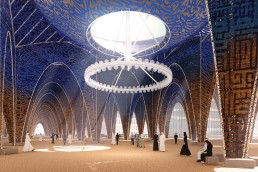
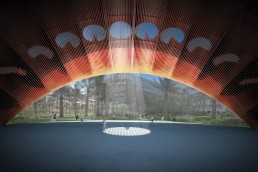
In the Ibn Al-Haytham Pavilion, this type of system is modified to create beams of vertical light with the power of 800 suns by concentrating sunlight through fresnel lenses at the roof. These beams are then re-concentrated at the raised floor level by a second fresnel lens field and onto the CPV cells which are arrayed in a naturally cooled plenum space at ground level.


The beams are set against an interior of mirrored walls to increase the effect of the visual field. The relative darkness of the room that houses the beam field insures that the beams are clearly visible inside it. The beams themselves change position as the heliostatic dual-axis hinges follow the exact location of the sun. This ever-changing composition is visible in two locations: the horizontal viewing aperture at the North elevation, and from within the camera obscura room on the South side of the pavilion.


View as seen from the North viewing aperture. The aperture itself is completely open with the concrete shell creating a cantilevered structure with steel reinforcing. Since each beam has the real ability to set fire to anything combustible in its path, the inside of the aperture has protective glass.


The first camera obscura was built by Arab scientist Abu Ali Al-Hasan Ibn Al-Haytham, born in Basra (965-1039 CE), who carried out practical experiments on optics in his “Book of Optics”. In his experiments, Ibn Al-Haytham used the term Al-Bayt al-Muthlim, translated in English as dark room. In the experiment he undertook in order to establish that light travels in time and with speed, he wrote: “If the hole was covered with a curtain and the curtain was taken off, the light traveling from the hole to the opposite wall will consume time.” He reiterated the same experience when he established that light travels in straight lines. A revealing experiment introduced the camera obscura in studies of the half-moon shape of the sun’s image during eclipses which he observed on the wall opposite a small hole made in the window shutters. In his famous essay “On the Form of the Eclipse” (“Maqalah-fi-Surat-al-Kosuf”) he commented on his observation: “The image of the sun at the time of the eclipse, unless it is total, demonstrates that when its light passes through a narrow, round hole and is cast on a plane opposite to the hole it takes on the form of a moon-sickle.”


Estimated (and perhaps optimistic) statistics:
> Area of lens field: 576 square meters
> Assumed operating efficiency of system: 15%-30% (40% cell efficiency – loss from lenses, angle obstructions, and heliostatic tracking)
> Resulting peak energy capacity: 86 KW – 172 KW
> Typical output per day: 1200 KWH
> Typical output per year: 400 MWH
> Cost per MWH: AED 300
> Cost savings generated per year: AED 120,000
> Construction cost: AED 4,000,000
> Payback: approx. 30yrs (cultural payback hopefully sooner than that)


Entrance to the camera obscura room from the South Elevation

Tweet this!Tweet this!

Tags: , ,