bLAGI HOME · Public Art

Public Art

You are currently browsing articles tagged Public Art.

An Ode to the Sun

Boulos Douaihy
Designed for Site #2 in Abu Dhabi, between Saadiyat Island and Yas Island.

land art generator
Design Submission for the 2010 Land Art Generator Initiative Design Competition

Artist’s descriptive text:
Our installation is a celebration of the sun’s “aura” on earth. It emphasizes the sun’s cycle during the day and year and quantifies and shows the energy produced by sunlight.

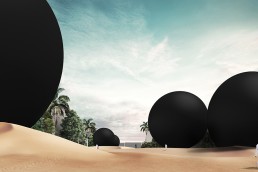
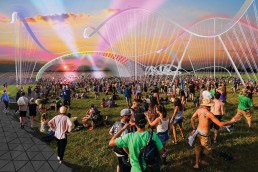
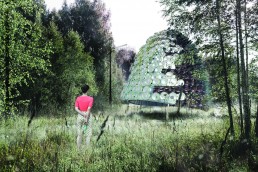
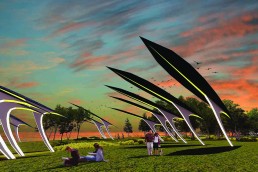
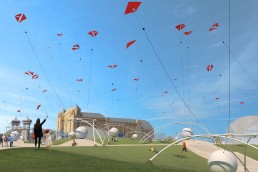
A forest of metallic geodesic spheres with a photovoltaic hemisphere rotate on their axis following the movement of the sun during the day, collecting sunlight and transforming it into electricity stocked in underground batteries, allowing their rotation.

land art generator

The energy collected during the day will be exposed during the night through light emitted from the same photovoltaic hemisphere. The more energy collected, the more the light is intense. Summer nights being the most lit.

The spheres start the day by welcoming the first sunrays at dawn and follow the sun’s path becoming self-sufficient sun watches. During the night, the spheres become lit crescents seen from afar, indicating the night time.

land art generator

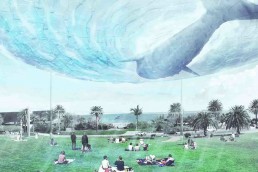
The Moon and the Sea

Our installation emphasizes the effect of the sun and moon on the sea by exaggerating the tide’s action on the shore’s outline.

The land, bound by the highway on one side and open to the sea on the other, is topographically manipulated to form mounds of different levels creating platforms hosting the spheres and disappearing into the sea.

As the tide goes up, the water surrounding the mounds create islands of variables sizes and shapes, continuously changing the shore line and putting the “photovoltaic spheres” in different situations.

land art generator

Sun Islands

Visitors to the “sun islands” can examine the spheres from the highway or can go island hopping and experience the different outlines created by the tide.

During the day, the spheres create shaded spaces allowing for potential camping or picnic spots. During the night, the spheres light up the park , where different activities can take place: jogging, music festivals, stars watching etc…

land art generator

low-res version PDF of submitted boards

Tweet this!Tweet this!

Tags: ,

Egal Center

Celestino Sebastiao
Designed for Site #3 in Abu Dhabi, on Airport Road near Masdar City.


Design Submission for the 2010 Land Art Generator Initiative Design Competition

Artist’s descriptive text:
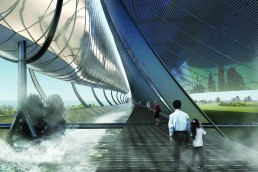
The vision is centered on integrating multi disciplinary fields knowledge to explain conceptual principles of design for a nature friendly power station that employs gravitational force to generate large-scale electricity (760 megawatts / peak).

Sustainable Architecture and Art – Precepts taken in consideration for site selection are related to specific constrains when analyzing features of urban development and consolidation, spatial distribution and specific characteristics of public services and equipments. In terms of impact on nature, a specific desk assessment has been carried out for each proposed site based on land utilization, impact on local fauna and flora, underground water disturbance and changes on wind flow. The proposed building footprint is a result of a study of United Arab Emirates traditional architecture of Forts and Mosques also its unique landscape features namely desert dunes. Therefore, three-separated irregular curvilinear type of structurally disintegrated solids has been adopted for the proposed building ground floor plan set up. However, a basement floor area, an outdoor public terrace located on the first floor, and finally a common roof element, interconnects these solids. The combination of built and empty roofed outdoor public spaces allows for the provision of shading areas on which natural ventilation will be taken into the building also allowing for daylight use. Finally, this strategy will help with the migration movement of birds nesting on the edge perimeter green buffer zone that will be protected integrally although detailed study on underground water disturbance may necessary as to assess any constrain caused by the proposed basement area. The proposed sculptural center will be spatially organized in the following manner:

A) Access restricted basement area to house industrial generators, the rotation system, and high voltage transformers, connection cabling equipment connecting to local power grid.

B) Ground floor area composed by 2no gravitational field spaces on which the solid bouncing displacement or gravitational tubes are installed and concealed on lattice structural elements. Postmodernism art galley area for public to contemplate the complexity of bouncing solid displacement along gravitational tubes based on stability of space objects which are used as force to generated large-scale electrical power. This floor will be built in structural masonry walling system with optimized opening and finished accordingly so to provide a clear barrier between outside and inside spaces.

C) First floor area with the same space arrangement from the floor below and composed mainly by a void space formed by gravitational fields in continuation from ground floor area. Learning facilities, management and technical control rooms and dedicated welfare areas finally, public outdoor panoramic terrace.

Geometrically, this floor is designed through orthogonal section of cones built using steel frame structures, which loads on ground floor structural walling system. These towers will be internally finished with frameless curtain walling system with opening units so to form a thermally controlled interior space and externally will be sculptured using a system of vertical repeated waved sun shading elements which design is inspired by the bending of Egal ropes also optimized through profitable variation, an important aspect of natural selection process.

Gravitational Field. Firstly, the term gravitational field is used in this context to designate the entire system composed by singular gravitational tubes assembled at a specific space, therefore, the proposed power station will contain two separated gravitational fields. Secondly, gravitational tube is designed to produce force by displacing up and down a homogeneous solid along a gravitational axis. The massbouncing solid is submitted under three basic quantum mechanics law:

1) Law of Equilibrium (static condition) Newton’s third law F1=F2, F1+F2=0

2) Law of gravity (moving down) Newton’s second law F=ma

3) Law of elasticity (bouncing up) Robert Hooke’s law F=k.x (series and parallel equation for forces acting along springs)

To maintain a self constant solid displacement along a gravitational vector, a system of acceleration valves are designed to help the system to regenerate its own momentum hence a series of displacement state can be written in this way:

a) Initial displacement (2 ➔ 3 ➔ 1 ➔

b) Auto regulated bouncing displacement (➔1 ➔ 2 ➔ 3 ➔

The stage 1 will be obtained through the design and diagram of forces acting along acceleration valves components, which will allow for a temporary decrease of acceleration in a period of time in between 5 to 10 sec. The bouncing gravitational system will be formed or constructed with the following components:

1) Supporting steel shell structure
2) Upper chamber with releasing and stopping devices connected to expanding holding encapsulated torus chain connected to spiral hairspring boxes and the displacement solid.
3) Stabilization box with tension spring to provide weight displacement with homogenous type of movement and help regulating the speed.
4) Bouncing solid or weight with a properly designated mass in kg will produce force used to rotate an electrical generator turbine.
5) Displacement axis or gear bar connected to the bouncing solid and used to direct the generated force to articulation lever arm located at rotation and torque box.
6) Tension box with impacting head and multiple spring coils arranged in discs and displaced in parallel (keq=k1=k2) and series (1/keg=1/k1+1/k2) patterns.
7) Rotation and Torque Box (r=r.f) to house the rotation torque that converts vertical force into rotation force applied on the rotation of a wheel system attached to an electrical generator blade through a chain system.

The design principles will consider the value of 760 megawatts/peak of electrical power production for future mathematical and physic modelling of gravitational tubes (76no gravitational fields x 2no generators of 5 megawatts capacity for each tube).

However, flexibility factors will be considerate as data for required amount of power should be provided by concerned authorities rather than being imposed by design limitations.

Development. The proposed sculptural power station is a result of interconnecting collaborative fields of knowledge with the intent of building world first conversion of force produced by stability of space objects along a gravitational field into a specific required amount of needed electrical power.

Therefore, overcoming issues related to storage or lack of enough force to produce the required amount of power as it has been happening with other forms of renewable sources. These factors allows the system to be universally valid without compromising its performance due to geography, time of the day and weather conditions. Further, the concept opts for versatility as it bases its design on single independent unit working to form a flexible and expanding system. Egal center will be an art installation that uses its bouncing system as asset for establishing an advance postmodernism art gallery and learning facilities dedicated to innovative ideas of applying scientific knowledge to resolve mankind needs and will be also make a positive contribution on the strategy of opting for a type of architecture that is a result of adaptive approach rather than the importation of archetypes.

Finally, we appreciated the initiative and used it as conceptual experimentation fusing different aspects of technological innovation which may leads for an efficient kind of sustainable development concentrated on providing the humanity with the next stage of freedom and security which comes with the feeling of saving our unique and only habitat, the Earth. It is more than the freedom experienced with the invention of aircraft.

low-res version PDF of submitted boards

Tweet this!Tweet this!

Tags:

Static Motion

Sherri J. Newman and Jen Earle
Designed for Site #3 in Abu Dhabi, on Airport Road near Masdar City.


Design Submission for the 2010 Land Art Generator Initiative Design Competition

Artist’s descriptive text:
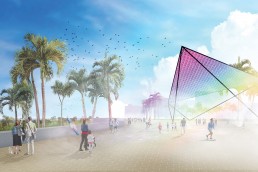
The concept for our land art generator is a response to the conditions of its environment. This was accomplished through site movement and patterns, local climate, and cultural geometry.

The viewing platform for the Land Art Generator will take place from the frame of a window, as local Abu Dhabi citizens and tourists circulate around the site. The movement, both by highway and airplane traffic from Abu Dhabi’s International Airport informed the design of the structure with the intention of conveying a sense of motion from within a static object. The subject would view the sculpture from the reference point of a car or airplane window and as the viewer rotates around the object varying perspectives are produced from different angles and in three dimensions.

Smart textiles are layered over the sculpture as a temperature sensitive skin accomplished by thermochromic dyes. As the ambient air temperature and light intensity change throughout the course of the day, the textile would vary in color and effectively act as both a visual thermometer and indictor of how much solar activity is being collected by the installation, giving a visual tangibility and aesthetic quality to clean energy consumption. Responsive textiles allow for environmental readings that will engage citizens.

The underlying geometry of the form is based on tangents, utilizing the cultural significance of triangles in Islamic architecture. An organic form emerged from this geometry, by patterning catenary curves around tangent points. Finally, the pattern used to layer soft PVCs onto the textile was inspired by the texture of date fields surrounding the site; evident from aerial views.

The lightweight, tensile design allows for minimal environmental impact, and a chance to present solar energy to a new generation of consumers.

The island,
carved by the machine,
fluid lines of the outer shell display the dynamic force,
motion contains the object,
Impenetrable boundary.

Nature maintains the periphery,
Containing from within,
The vastness of the island.

The object,
Engaging,
contained at rest,
invites the subject,
into motion.

low-res version PDF of submitted boards

Tweet this!Tweet this!

Tags: ,

Michal Teague and David Moore
Designed for Site #3 in Abu Dhabi, on Airport Road near Masdar City.


Design Submission for the 2010 Land Art Generator Initiative Design Competition

Artist’s descriptive text:
Sunset (running on empty) is a counter monument heralding the sunset of the era of petrol-based car culture. It comprises a purpose made video artwork shown in a replica installation of the iconic drive-in cinema, featuring a large screen, advertising marquee and car park that is the electricity-generating component of the design. The video artwork is a temporal-based narrative depicting a car driven continuously until the petrol tank runs dry. The car will remain permanently parked in the middle of the renewable energy generating ‘car park.’

The drive–in cinema is an icon of the 20th century. Sunset (running on empty) acts as a counter-monument marking the sunset of large petrol-guzzling cars. A drive-in cinema is an artefact from a carefree era, before knowledge of climate change and the finite nature of carbon-based resources.

The word ‘Sunset’ refers to the end of the day, and the inevitability of change, it is also commonly used to describe an era that is coming to a close, as well as being a popular name during the heyday of the drive-in cinema.

The drive-in cinema initially seems deliberately out of context in the UAE. A nostalgic folly from another time and place. However, it speaks to the global and interrelated nature of the need to adopt clean and renewable energy sources.

Drive-in cinemas were traditionally sited on the outskirts of a city with easy access to a main roadway similar to the conditions existing at Site 3 Abu Dhabi. The advent of the VCR and increasing land value, meant that many have now become shopping centres and housing developments. The drive-in like oil is becoming scarcer, there now being only 700 odd left in the world.

Video installation–a car is filled with petrol then starts its final drive in and around Abu Dhabi. The drive is documented until the petrol is finally used up, eventually coming to rest at its final parking site the Sunset drive-in cinema.

Screen – known in the original vernacular as a ‘sheet.’A large outdoor screen powered by an open solar field. It is envisaged the screen will be placed in a westerly direction on site, approximating where the sunsets.

Marquee–an illuminated sign advertising the session times of the film ‘Running on Empty’ to people passing the site.The title can be interpreted literally as referring to the fuel gauge of a car and more broadly fossil fuels becoming scarcer. Additionally nuance comes from the two ‘coming of age’ genre films both titled ‘Running On Empty’. An Australian film made in 1982 featuring a young man involved in street drag racing and a 1988 U.S. production about a fugitive family on the run from the FBI and the eldest son seeking to live a life of his own.

Parked car – the ordinary car is permanently parked on site in the midst of the electricity-generating field after featuring in the video production.

Ramps– a replica of a Drive-in Cinema car parking area laid in a fan-shape. Rather than the more traditional material of asphalt it will be anelectricity-generatingfield with the solitary car, mutely watching itself on screen.

Option A: The preferred technological option for this component of the installation is to use Solar Roadway technology currently undergoing prototyping in the U.S. Having communicated with the developers full-production is probably 2 years off. However it would provide the option of the audience being able to safely walk or even drive on the electricity-generating surface. The product can also have LED lights embedded to create patterns, images and text. In respect to dust and sand, it will be able to be cleaned when required using a street sweeper.

Option B: a ‘car ramp’ formed by a black field of currently commercially available photovoltaic solar panels.

The dominant features of Site 3 Abu Dhabi – Airport Road near the Masdar City Site, are the surrounding roadways that delineate its boundary. The art installation foregrounds the role of the car and human behaviours, which influence the site, just as much as the naturally occurring phenomena – wind, sun, wildlife, vegetation, and occasionally water. In this way, the drive-in cinema installation is truthfully integrated into the surrounding environment and landscape.

The solar electricity-generating field will cause minimal interference with the ground of the site. The natural vegetation of the site would be permitted to grow in and around the art installation to enhance the feeling of it being an abandoned place from another time.He design uses a portion rather than the whole site.

Solar roadway 300 panels would generate 2.28MWhr – based on 15 % efficiency and a conservative 4 hours of sun per day. While 500 panels would produce an estimated 3.8MWhr.

The project design aims to be accessible to pedestrian foot traffic. With the solar roadway technology there is the potential for it to become a playground for the public. This would occur by using the embedded LED lighting to create games and maze designs for example.

The screen and car park ramps have the potential to become part of the public infrastructure of Abu Dhabi becoming a site to stage events and to screen the work of video artists during film and arts festivals rather than a static art installation.

low-res version PDF of submitted boards

Tweet this!Tweet this!

Tags: ,

Khoury Levit Fong
Robert Levit, Rodolphe el-Khoury, James Dixon, Lindsay Hochman, Khalid al Nasser, Melissa Lui
Designed for Site #2 in Abu Dhabi, between Saadiyat Island and Yas Island.


Design Submission for the 2010 Land Art Generator Initiative Design Competition

Artist’s descriptive text:
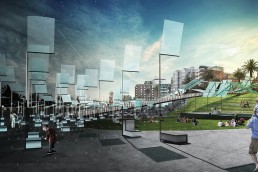
A constructed dunescape…with southern slopes of mirror-bright polished stone, lifts towards the sun. Concave eye-shaped surfaces reflect light upon pipelines, superheating their liquid contents and powering electricity generating steam turbines housed beneath their crests.

A rich pattern of mirrored eyes luminous with the sun by day and shifting patterns of LEDs by night . . . the dunescape blinks.

Solar Dunes adapts the machinery of solar powered steam generated electricity. But, here the machinic array of mirror-like surfaces is bound up in a topographical form: the dunescape.

The machine does not sit in nature as it once did (factories in the landscape), but neither does nature camouflage the machine and its detritus. Here the dunes look natural but are a work of geometry and artifice. And the polished mirrors, the piping and its supports interpose within the forms of the dunescape an element of even more obvious artifice. Taken together, the dunes and mirrors create a challenging equivocation between the natural and the artificial. The eye-like surfaces blinking in the dunescape uncannily animate the inanimate –the prosthetic quality of machinery that reproduces qualities of the body is now writ into the field of a technical landscape. The ecologically sound solar production of electrical energy is bound up in a newly conceived esthetic of landscape.

These dunes are built and stabilized: an open mat of concrete, mostly below the surface, holds their form and patterns their surface. Concrete ribs and planks form the substrate for the parabolic curvature of the mirrored surfaces. These may be of polished stone or metal as budget and performance criteria permit. The dunes rise and subside, making for a richly varied array of forms, both to look at and to occupy. Under several of the larger dunes –over ten meters in height—powerful electrical turbines will be housed. Pipes onto which the mirror surfaces reflect intense light, will carry superheated liquid to drive the electricity-generating turbines.

The solar dunescape –artificially patterned, scintillating day and night, is designed to be apprehended at different speeds, at different scales and in different media. Experienced on foot it is an immersive landscape between highway and water. The dunes, large in scale, are a park. From the northern edge, by the water, they hide their technical apparatus, and appear as somewhat excessively regular sand dune landscape. Seen from a speeding car, the patterned surfaces come into view stretched along the horizon at the speed of a blink. From an airplane, the pattern of the dunes takes on an iconic character: a logo-in-the-land identified with ecological solarpower generation and the esthetic re-conception of an industrial landscape. On a computer screen the site is patterned at a scale that is visible on Google Earth and establishes itself as logo-scape linked to the innovative synthesis of sustainable power generation and art to be established here in the UAE.

By night Solar Dunes turns into an informational ornament. The trajectory of air travel between Abu Dhabi and international destinations is mapped as trailing light patterns upon the mirrors of the dunes. LEDs embedded at the foot of each mirror brighten and dim set by the arrivals and departures from Abu Dhabi International Airport. This pattern of light-play treats information as ornament. Animated patterns are generated by the cosmopolitan globalized circumstances of life in Abu Dhabi. The pattern of lights of this energy landscape may be, in turn, used as a logo in a variety of sites: as a luminous floor pattern of the Abu Dhabi airport ticket concourse, as a screen ornament app in iPhone, as a splash screen for Emirates airlines, and elsewhere. . . This image of the new electrical landscape will be an emblem of a convergence: between sustainable energy production and environmental art.

Solar Dunes uses a conventional energy generating strategy in an unusual manner. Mirrored arrays have been used in numerous locations to melt salt, which is then pumped to steam turbines where it vaporizes the water used to drive the turbine. In our proposal we have considered two possibilities. First, a lower tech use of polished stone and a heated liquid such as glycol to produce steam. Such materials require less maintenance and are more compatible with the use of Solar Dunes as a park. The second option is that the mirrors be more conventionally machined metal mirrors—producing a maximum of heat and thus electrical power.

low-res version PDF of submitted boards

Tweet this!Tweet this!

Tags: , ,

NET

Sang Hoon Lee
Designed for Site #3 in Abu Dhabi, on Airport Road near Masdar City.

land art generator
Design Submission for the 2010 Land Art Generator Initiative Design Competition

Artist’s descriptive text:
Recycled Plastic Woven Structure (LDPE) with Amorphous Flexible Solar Films

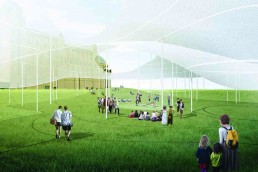
It is a thin net of off-white plastic sheets (Recycled Low-Density Polyethylene). From a bird’s eye view, it appears like a white curving fabric floating slightly above the earth. Dispersing sunlight under the UAE’s strong sun radiation in the daytime, this vast surface area of plastic gives a viewer the illusion of it (the surface) being surrounded by a dim haze of light.

land art generator

The horizontal space under the plastic structure is approximately 0.56km long and 0.25km wide. The texture of the net is mostly dense and homogeneous, but in parts, relatively loose and sparse so that it creates a different sense of space with the difference in the amount of light coming in.

A number of 3 to 4m high Y-shaped supporting metal structures uphold the net, standing on the ground. These vertical elements are arranged keeping relatively consistent intervals, producing similar rhythm of natural woods. With the existing enclosures (a thin layer of woods and highways circulating around the perimeter of the site), these broad and wide artificial installations blend with the existing landscape as if there exist two different woods: woods within woods.

The net is 0.28m thick. It is a woven structure of LDPE plastic sheets. It is an aggregation of a single plastic unit (0.28m high x 2.5m long x 0.03m thick) assembled horizontally. Each has five 0.03m wide and 0.14m long slots; a slot of a unit is set in that of the other. A number of sheets are fixed to each other in the same way and transformed into an open canopy structure.

land art generator

The vast artificial surface is a thin and transparent layer where people encounter and sense the environment. The thousands of openings created serve as a frame and a new lens through which viewers can look up and observe the various changes of landscape. The movement of the sun is seen through lozenge-shaped rooms between plastic sheets and the setting sun is felt by the changing shadow pattern on the ground. Local birds may come down and stay on the net for a while or build their nests on the structure.

Small and low soil mounts are distributed on the site. These viewing platforms are placed where the fabric of the net is sparse so that people can mount on that platform and have a view over the wavy plastic surface. Stretching out their head above the net, visitors may see glaring white light reflected from plastic sheets like looking over clouds in the sky.

An amorphous solar film (20W, 17.5V, 1.275m x 0.385m, 0.90kg) is bendable due to its extremely thin (less than 1mm thick) and flexible characteristic. The photovoltaic units are mounted on the curving surface of the net maintaining the units’ faces perpendicular to the sun. The eight 0.018m diameter holes are made on each plastic sheet for consistent detailing method for any kinds of attachment to the structure. Disposable plastic fasteners (tie straps) can be used to tie the attachments such as solar panels, LED lights and electrical wires to the structure. Those electrical devices are exposed to the atmosphere but not reachable from the ground and are protected by additional finishing materials; a transparent plastic tube wraps round a supporting structure where electrical wires from photovoltaic units on the roof pass down and connect to an electrical grid on the ground.

land art generator

Some solar panels are connected directly to bar-type LED lights (not to the electrical grid) and work autonomously with a Light sensor and a controller set next to them; storing solar energy in a Lithium-ion rechargeable battery in the daytime and emitting light at night.

With around 3,200 amorphous solar units(20W) installed on the net, the installation has a capacity to generate 50Kwh clean renewable energy (around 75MWh a year).

Architecturally, it is a field under a wide canopy structure where meetings and events such as a market can take place. In the daytime, the area is open and both residents and tourists can access and wander around enjoying open air activities. At night, with the LED lights on, the still environment will convert into a place for a festive event for anyone.

low-res version PDF of submitted boards

Tweet this!Tweet this!

Tags: ,

SOLARIS

Oleg Lobykin
with renderings by Transparent House
Designed for Site #2 in Abu Dhabi, between Saadiyat Island and Yas Island.

land art generator
Design Submission for the 2010 Land Art Generator Initiative Design Competition

Artist’s descriptive text:
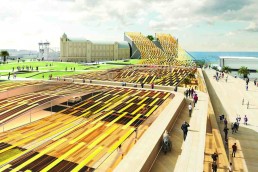
Solaris is a sculptural art installation comprised of hundreds of photovoltaic panels arranged in the pattern of a familiar cultural ornamental. This approach combines the benefits of modern technology for producing solar energy as electricity with a visual representation of traditional images having cultural significance. Due to its size and proximity to the airport, the site offers an opportunity to showcase a design from an aerial vantage point that is quite distinctive and provides an attractive alternative to a strictly utilitarian configuration of panels in flat straight rows.

From an aesthetic perspective, this approach offers several benefits. Panels may be manufactured in a handful of different geometric shapes, such as triangular and rhomboid, and then arranged in a virtually unlimited number of configurations to create customized patterns of design. This versatility allows the concept to be replicated in various locations with minimal cost for customization, straightforward and scalable manufacturing and installation, and site-specific design specifications for pattern development.

land art generator

From an environmental perspective, solar power is a renewable resource that is ideally suited to the site. Sunlight is plentiful throughout the year, and because the site is already mostly devoid of vegetation a photovoltaic installation would add to the renewable power base without posing any significant risk to existing flora and fauna.

Solaris will contain 1,418 photovoltaic (PV) panels and will have a peak capacity of 45 MW. This amount will be sufficient not only to provide for the ongoing energy needs of the site itself, including an interactive visitor center, but also for other commercial or residential buildings in the area.

land art generator

On the side nearest the coast, the PV panels will be arranged along the coastline itself. They will integrate the design seamlessly into its environment and also mark the contour of the coastline at a particular point in time so that any future changes in it will be easily visible.

In addition, there is 25m high dome structure integrated into the design which can serve as a visitor center and environmental science interactive museum that collects and presents information about the effects of climate change around the world.

Multi-media exhibits could connect viewers in real time to events occurring in particular places on the planet, such as rainforests, glaciers, oceans, etc. and act as a historical record of changes over time.

land art generator

The name “Solaris” is taken from the novel of the same name published in 1961 by Stanislaw Lem. The novel depicts the relationship between people of the future and “the rational ocean”, which the artist sees as a metaphor for nature itself. The issue at hand is the coexistence of human beings and the natural environment.

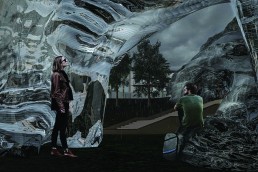
The arrangement of the solar panels in this proposal is intended to be illustrative of the concept. Airline travelers to and from Abu Dhabi will be able to view the design as they approach or depart the city by air, while visitors to the site at ground level will experience a sensation of passing along the coast of an “industrial ocean” by car from the road. Stopping at the site, visitors will be able to walk under the “canopy” of an “industrial jungle” to the dome-shaped visitor center and observe any changes in the shape or location of the coastline that may have taken place since installation. In this way, viewers will see Solaris very differently depending upon their perspective in relation to it. The Solaris installation will generate environmental awareness using the universal language of art.

low-res version PDF of submitted boards

Tweet this!Tweet this!

Tags: ,

Tetras

Ann Preston, sculptor and Roger White, architect
Designed for Site #3 in Abu Dhabi, on Airport Road near Masdar City.

land art generator
Design Submission for the 2010 Land Art Generator Initiative Design Competition

Artist’s descriptive text:
A Sculptural Artwork Using Aperiodic 3-D Tiling Patterns to Create a Pavilion, Plaza and 6MW Solar Field

Mathematical and visual principles that evoke the long, Middle-Eastern tradition of architectural tiling patterns are central to this project. The central building structure, which is the hub of an expanded, three-dimensional tiling pattern, is a sculptural artwork composed of a combination of transparent, translucent and opaque solar cells. This building is an open-air pavilion and is formed from just four tetrahedral blocks in different generations of scale. The two- and three-dimensional patterns generated by the assembly of these tetrahedral elements begin in a single inscribed plaque in the building’s entrance and expand outward to fill the entire site: first to form the Pavilion itself and eventually to encompass a multi-use outdoor plaza and gardens and more than 500,000 square feet, or about 55,000 square meters, of solar generator fields.

land art generator

The ultimate goal is to make solar energy plants beautiful, transforming them into cultural resources that are pleasing to the eye and mind, and enriching the life of the community. This combination of art and clean energy would be an inviting place to visit, becoming a center of local and international tourism.

land art generator

This artwork would produce more than 6MW of electrical power. Because of the inherent scalability of the tiling designs, the project buildings and fields could be easily reduced in size, or expanded indefinitely to even grander solar arrays.

The sculptural, central building, an open air pavilion, is the nucleus of the pattern for the entire site. The solar panels are attached to a geodesic framework and cover most of the building. In the eastern section is a tetrahedral dome filled with translucent, frosted colored glass forms. The floor is tiled in an expanding spiral pattern using single faces of the tetrahedra. From an observation deck, visitors will be able to view the unity and beauty of the overall design, including the complex pavilion design, the plaza below, and the more distant solar array fields.

land art generator

The building is intended to be a solar cell demonstration using custom photovoltaic glazing which can be screened between sheets of glass as Building Integrated Photovoltaics, in varying patterns, degrees of heat conductivity, opacity, shapes and colors. The solar cells are intrinsic to the building materials. The geodesic qualities of the basic three-dimensional tiling elements that comprise the building provide superb structural strength, belying the graceful almost diaphanous visual appeal of the pavilion.

The extraordinary two-dimensional, mathematical, architectural tiling patterns of the Middle East are based on a small set of shapes and subdivisions, which can fill the void with repetitions and permutations. Here, we use a three-dimensional tiling pattern, which functions similarly. It is composed of four, four sided forms or tetrahedra. These are based on the work of the renowned mathematician, Ludwig Danzer.

land art generator

The tetrahedral have interesting and complex properties:

• They can be combined in patterns that fill 3D space without voids.

• These patterns are aperiodic. Unlike bricks, they cannot be assembled into a single, regular pattern that repeats. Instead they radiate out in varying angles and combinations.

• The ratios of the edges of each tetrahedron are related to the Golden Mean, a ratio of proportion found abundantly in nature and which has been employed for centuries to generate visually pleasing art and architecture.

• Each tetrahedron can be built from a subset of smaller versions of these same four forms, as can the smaller versions in turn, ad infinitum.

• 2D patterns can be derived from individual faces of the tetraheda, when the edges of the smaller subsets of forms that comprise a tetrahedral tile are marked on each face of the tetrahedron. As ever-smaller subsets of tetrahedra are included, increasingly extensive, elaborate 2-D and 3-D patterns can be produced.

All of the forms in the building, plaza, and solar generator fields are composed of different scale generations of these four forms as they manifest themselves in two and three dimensions.

The Solar Pavilion is surrounded by a plaza, which continues the tiling designs of the building and its flooring. This area provides a very simple, drought tolerant (xeric) garden with a few native shade trees and patterned areas. All vegetation is to be designed in collaboration with local, horticultural expertise to employ indigenous, self-sustaining plants. The plaza would embrace the importance of the sun. It would contain: a large sundial, or solar clock; a café; and exhibition spaces.

land art generator

There is a mathematical substructure to music, which promotes a sense of rigor and beauty, but need not be understood consciously. The role of structure in this work is similar, and suggests an affinity between music and Arabic tile art.

low-res version PDF of submitted boards

Tweet this!Tweet this!

Tags: ,

SunRainForest

superTEX
Valentine Troi, Georg Wieser, Stefan Strappler, Martin Jehart, Thoralf Krause

Designed for Site #3 in Abu Dhabi, on Airport Road near Masdar City.

land art generator
Design Submission for the 2010 Land Art Generator Initiative Design Competition

Artist’s descriptive text:
As the natural rainforest shows a wide variety of functions the unique SunRainForest Abu Dhabi implements natural skills to convert natural resources to sustainable outputs like electric energy and water.

The Forest Leafer opens up to the sky to collect sun and rain much like a budding plant, while other designs are focusing on using wind and other natural resources like dew to create a integrated transformation from the tropic rainforest to the SunRainForest of Abu Dhabi.

land art generator

The Leafers are build with the brandnew lightweight construction technology splineTEX®, which is based on fibre reinforced plastic and appropriate for the realization of architectural double curved structures; the flexibility of the material allows production processes without moulds so that each Leafer can be designed and produced individually without increasing costs (mass customization instead of mass production).

The revolutionary splineTEX® was invented and developed by the applicants together with global partners to answer the strong demand for free shaped design technics.

land art generator

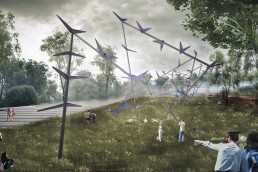
The Forest Leafer is the core plant of the SunRainForest and combines effective energy collection with unique artistic design. The Forest Leafer finally grows to overall heights 3 to 9 meters and always moves the head in two axis towards the sun to catch most of its valuable rays. In the rare case of rain, the Forest Leafer adjusts upwards to collect plenty of rare sweet water to regulate the mircroclima inside the SunRainForest.

- The multi layer skin embeds flexible solar modules with wires through the veins. The full diameter of the leaf varies from 2 – 6 meters.
- The shaft connects the functional leaf with the solid basement in a flexible way (the shaft has similar characteristics like the pole for pole vault) to allow the horizontal and vertical movements to follow the sun. The shaft combines static and logistic requirements, such as forwarding of energy, water and light.
- The root contains the intelligence to steer and control the ForestLeafer by connecting the individual Forest Leafer to the SunRainForest and its visitors by energy output and interactive systems.

land art generator

Intelligent natural parameters are defining the exact position of each different “plant” inside the SunRainForest to guarantee high effectiveness of diversified “plant” functions. Due to the proximity of the site to the airport, the design regards both – top view an the human eye view.

- The Forest Leafers “grow” to different heights and leaf diameters according to its position and distance to each other throughout the whole area.
- The wind collector plant is placed on the northwest streetside of the area to obtain the maximum wind energy.

The SunRainForest Abu Dhabi produces 904.000 kwh per year based on state of the art solar and wind energy technics and spread fog of 600.000 liters of rainwater for a postive microclima influence by rising relative humidity.  

low-res version PDF of submitted boards

Tweet this!Tweet this!

Tags: , ,

PV DUST

George Legendre, Emanuele Mattutini, Jean-Aime Shu,
and Alfonso Senatore

Designed for Site #3 in Abu Dhabi, on Airport Road near Masdar City.

land art generator
Design Submission for the 2010 Land Art Generator Initiative Design Competition

Artist’s descriptive text:
Introduction
PV (for Photovoltaic) Dust is a site-specific Land Art installation producing clean energy with astonishing efficiency. It is strategically located on the outskirts of Masdar City, the first zero-carbon-footprint agglomeration in the world, next to Abu Dhabi Airport, UAE.

PV Dust covers 175,000m2 of desert ground with a new breed of photovoltaic technology, aggregating into a cloud of energy-producing dust. The PV Dust cloud has an eerie presence, recalling the great desert sand storms of the Gulf.

Below the cloud, a network of sand-coloured gravel paths striates the territory. Seen from the flight path of incoming, airport-bound jets, the forking pathways assume the appearance of traditional Islamic lattices. Made of sand-colored gravel, Pebbles and crushed roof tiles, this landscape relies on a distinct desert palette and does not need to be watered.

land art generator

At the heart of PV Dust lies a new lower-ground complex of leisure and retail amenities, conveniently located on the Masdar City Light Railway Transit system. The complex facilitates access to an otherwise isolated location and helps maximize the commercial potential of the site.

Future Visions
PV Dust, the photovoltaic farm of the future, is made of 279 cubic modules of 25m*25m*25m featuring innovative, omni-directional PV technology.

Our proposal for a new type of PV farm works with, and extends, the green transportation guidelines issued by and for the neighboring Masdar City. At the time of writing we assume that the LRT will be located underground. If not, the position of the PV module grid takes into account the hypothetical route of the LRT and could be adapted to work with an over-ground light transportation system (simply by removing those modules standing in the way).

land art generator

Hence PV Dust is a scenario as much as a proposal. Depending on the amount of energy required, the modular PV Dust cloud could be resized to meet those needs, and then grow incrementally over an unspecified period of time, like an orchard or vine.

A Compact and Powerful Idea
At peak power, the Sphelar® Cells used by PV Dust produce around 40 MW (please refer to next section). To generate a similar amount of electricity, an alternative solution using traditional flat PVs would require 310,159m2 of polycrystalline photovoltaic panels.

Our installation fits on just 174,375m2 of land. This is about 57% of the catchment of flat PVs. Our proposal has a substantially smaller footprint, it does not block access to the ground, and it spares valuable earthbound resources.

land art generator

How Sphelar® Works
Flat solar cells are unable to effectively harness indirect light. Moreover, in order to obtain a stable supply of power, their orientation needs to face the sun. By contrast, the new Sphelar® Cell technology developed by Kyosemi Corporation, Japan, captures light from all directions at once, including reflected and diffused light. Its spherical light-receiving surface does not need to track the sun, and hence, Sphelar® achieves unprecedented levels of energy efficiency.

With a diameter of a mere 1 to 1.5mm, Sphelar® Cells can be connected in parallel or in series. This enables diverse spherical products to be created, such as dome-shaped solar cells and “flexible” solar cells aligned on soft film substrates. Our proposal assumes Sphelar® Cells are grafted on a light plastic sphere of 500mm diameter, called a Host. Collectively, the Hosts make PV Dust.

Art Installation / Proper Power Plant
PV Dust functions as a proper power plant. Solar irradiation is collected by the Sphelar Cells, which generate DC electricity. DC electricity is converted into AC electricity by Inverters. Each 25m*25m bay has its own Inverter, located at its base in a small buried plant. Once DC is converted into AC, 20 11kV Transformers transform the voltage and pass it to 4 Main Network Transformers that feed it to a switch board. These devices are located in an underground plant on the edge of the site, cooled via a passive ventilation system (labyrinth cooling). Subsequently the power reaches end users via the power grid. PV Dust supports 3 densities of energy-producing cloud, with commensurate levels of performance.

(a) Small Plant
Distance Between SPHELAR® Hosts: 3.125 meters
Total Number of Hosts: 175,770
Total Number of SPHELAR® Cells: 12.4m
Total Annual Energy Produced: 25,472,675 kWh/yr
Total Number of UAE 3-Bedroom Houses Powered: 5,095

(b) Medium Plant
Distance Between SPHELAR® Hosts: 2.5 meters
Total Number of Hosts: 297,693
Total Number of SPHELAR® Cells: 21m
Total Annual Energy Produced: 41,723,767 kWh/yr
Total Number of UAE 3-Bedroom Houses Powered: 8,345

(b) Large Plant
Distance Between SPHELAR® Hosts: 1.92 meters
Total Number of Hosts: 460,350
Total Number of SPHELAR® Cells: 32.5m
Total Annual Energy Produced: 63,821,598 kWh/yr
Total Number of UAE 3-Bedroom Houses Powered: 12,767

land art generator

Public Visitors’ Centre
PV Dust will become a local landmark for residents and tourists. With no car parking provided, only public transport, visitors will board Masdar City LRT and alight at the heart of a lower ground complex of galleries, restaurants, and shops.

All retail and leisure amenities are laid out around deep patios that maximise the influx of daylight, while providing cool and shaded peripheral galleries.
Visitors will perceive the cloud of PV Dust from every corner of this lower ground complex. Should they wish to visit the installation itself, they can use the public stairs on either side of the LRT platforms to reach the ground floor and walk though the gravel pathways for a quick tour of PV Dust.

land art generator

low-res version PDF of submitted boards

Tweet this!Tweet this!

Tags: ,

« Older entries § Newer entries »