bLAGI HOME · Public Art

Public Art

You are currently browsing articles tagged Public Art.

The following is part of a lecture that we gave for the AIA Middle East CES Course on the topics of Sustainable Design and Regional/Urban Design & Planning.


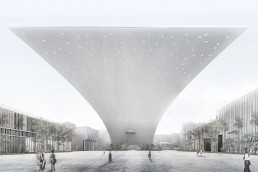
In 2008, we designed a solution for an iconic tower for Dubai (as a part of a design competition) that incorporated the technology of the solar power tower, along with passive cooling chimneys, into the artistic expression of the building. The tower powers itself and Za’abeel Park in which it is conceptually situated. Another design for a mixed-use tower, the 10MW Tower integrates three active systems: concentrated solar power, solar updraft, and horizontal axis wind into a building that produces 10x its operational demand load. The idea of an extreme integration of renewable energy infrastructure into the design of buildings offers a way in which architecture can exist for a third humanitarian purpose.


Architecture has served us firstly to provide shelter and functional space within which we work and reside. Its secondary role has been as an aesthetic amenity to our shared and private space. Architecture’s public face has a very important role to play, with every edifice signifying its purpose and declaring its personality, its regard for the public realm, and its relationship to human activities. Some buildings accomplish this function in very serious ways, both classical and modern; others with a sense of irony, but even those that prefer to ignore this role end up making some of the loudest statments.


What the technological revolution in renewable energy offers architecture is yet a third purpose which is closely aligned with the first two. While conventional power generation facilities that use coal, natural gas, petroleum, or uranium as their fuel source require large areas of land far removed from population centers, the newer forms of electrical generation do not pollute in their operation and so can be brought back into our urban centers and residential suburbs.


With this shift already occurring in small and medium scale installations, the question is: can new buildings actively participate in the energy generation infrastructure of our cities by producing more power than that which is consumed by their own operation? In essence, the idea of the separate power plant goes away and instead the function is integrated into the commercial and residential constructed environment in a way that shares cost, distributes generation, and allows buildings to pay back their own embodied carbon footprints with the clean energy they provide to the existing city around them.


It is interesting to note tangentially here that early in the age of public electrical power utilities (before transformers were able to produce high enough voltage for efficient long distance transmission) fossil-fuel powered generation facilities were by necessity located within urban centers. And in this context, the responsibility towards aesthetic amenity was heeded well.


Power plants were designed to fit within the architectural languages of the day, and in fact, their programmatic requirements contributed greatly to the evolution of the art with influence on early modern architects such as Otto Wagner, Tony Garnier, Peter Behrens, and later on, Futurism (via Antonio Sant’Elia) and the Bauhaus.


As more and more energy generation infrastructure was able to leave the city behind, it lost its relationship to architecture, especially with regard to that second humanitarian purpose of architecture that we mentioned: public amenity. It became pure utility—something to drive quickly by and hazardous to public health.


The notable exceptions in the latter half of the 20th century have been in cases in which the facilities remain in more urban settings, such as integrated within university campuses, or substation enclosures within the city.


This almost complete divorce of architecture and art from utilitarian power generation infrastructure has in many ways continued into the present as it pertains to utility-scale renewable energy production. In some cases, this has led to push-back within communities that find themselves in close proximity to large-scale utilitarian solar and wind installations.


This is less the case with smaller-scale generation, which allows for photovoltaics and small-scale wind applications to be integrated into the building design. BIPV innovation especially has made it possible for designers to provide a percentage of on-site renewable electricity, and in some cases, with the necessary assistance of good passive energy conservation design, provide 100% or more of the operational power requirements, resulting in net-zero buildings and developments.


But, as we know, the construction of buildings can consume up to 100 times the energy that the building consumes over the course of one year of operation. What the integration of larger-scale renewable energy systems makes possible is a more true zero-impact status (or what you can differentiate by calling ‘positive impact’) that takes into account all of the energy required to construct, operate, and eventually decommission the facility. Depending on the size of the building, its durability and adaptability, and its initial ecological footprint, the energy generation should be between 3x and 10x the operational use in order to provide a carbon payback period between 15 and 30 years. It will be necessary to establish an interdisciplinary approach to urban planning at the city level that provides incentives for developers to make this type of investment in infrastructural public largesse. But if the proper public policies, smart grids, and feed-in-tariffs are in place, it may be possible that these buildings could become a good return on investment.


There are many who are thinking along these lines, searching for ways of treating renewable energy technology as a design element that can work seamlessly with architectural expression. For the most part, these ideas have been incompatible with existing markets and incentive structures. It is a significant enough investment to construct a building by conventional standards to satisfy the programmatic requirements and smooth operations of the first use. And the cost of energy is relatively inexpensive, which provides disincentive to the proactive adoption of this type of hybrid building.


It occurred to us in the autumn of 2008 that there may be an easier adoption of aesthetics with larger-scale energy infrastructure if it were to occur within the genre of public art. Public art serves many purposes. It teaches, inspires, adds pleasure and interest to our days. It generates tourism and increased economic development. It gives us pause to question our assumptions about place, space, materials, and the meaning of things, and it generally strengthens our communities in ways that are innumerable and defy explanation. Can public art do these things and more? There are many examples of crossover between public art and objects of utility.


It is sometimes difficult to draw a clear distinction between landscape architecture and land art (Betsy Damon’s The Living Water Garden in Chengdu, China is a good example: the art-park serves as a bio-filtration water purification system for the river). Sometimes there is a strained distinction between public art and architecture (consider Bernard Tschumi´s Follies in Parc de la Villette Paris, for example). So then what about between public art and energy generation infrastructure?


Many traditional works of land art, such as those by Robert Smithson and Richard Long, use only natural materials; but there are others, such as those by Water DeMaria, Michael Heizer, Nancy Holt, Cristo & Jeanne-Claude to name a few, that incorporate synthetic materials (metals, fabrics, concrete) into the works. So, inspired by our love for land art and by the greater proliferation of the integration of renewable energy on-site power generation systems into the eco-millennial architecture of the past decade, we set out to discover how large-scale works of public art could be used as power plants for cities.


We immediately brainstormed an international design competition. For while we could find some great examples of public artworks that powered themselves with solar panels, there did not seem to be sufficient extrapolation towards a greater fusion between art and this particular type of utility or infrastructure art.


As a part of the Land Art Generator Initiative, we put together an online catalogue of renewable energy generation technologies that we hope can be a source of inspiration to designers who participate in designing land art generators, or who are interested in applications in other contexts. It is important to note is that there is a lot more out there than what we see in the everyday. In fact there are more than 50 different proven methods of harnessing the power of nature in sustainable ways. Some of the more interesting examples that may be applicable as a medium for public art installations are the organic thin films which are flexible and offer interesting hues and textures, piezoelectric generators that capture vibration energy, and concentrated photovoltaics, which allow for interesting play with light. But the possibilities are endless and new designs are coming into the market all the time that can be artistically integrated into large, conceptual installations.


In early 2009, we came up with a few ideas of our own utility-scale energy generating artworks at the start of our planning process in order to explain what it was that we were looking for. One of these provisional concepts incorporated a modification of concentrated photovoltaics, another used artfully placed wave buoys. At the same time we formally established the Land Art Generator Initiative (LAGI) identity and launched the competition on January 15, 2010 at the World Future Energy Summit in Abu Dhabi.


The design brief was fairly simple—the artwork was to capture energy from nature, cleanly convert it into electricity, and transform and transmit the electrical power to a grid connection point to be supplied by the city. Consideration should be made for the safety of the viewing public and for the educational activities that may occur on site. We asked that the design be constructible (rather than theoretical) and that it respect that natural ecosystem of the design sites. We encouraged interdisciplinary collaborations between artists, architects, landscape architects, engineers and scientists.


The jury that we put together was as interdisciplinary as the teams that participated, with top professionals from the worlds of art, science, architecture, urban planning, sustainability, and utility. From the UAE, we were very lucky to have Khalil Adulwahid and Omran Alowais. We also were fortunate to have Lukas Sokol with Abu Dhabi Urban Planning Council, Reuben Andrews with DEWA, and Georgeta Vidican from Masdar Institute of Science and Technology.


We gave artists the choice between three very large urban sites: one in Dubai and two in Abu Dhabi. The sites were theoretical but they were chosen because they all fit the following three criteria: 1. they are not slated for development in either of the city’s long-term urban plans, 2. they combine the perfect mix of adjacency to natural beauty and proximity to urban areas, and 3. they have ample access to renewable energy resources. We chose sites that would inspire the minds of the design teams, as well as the residents, local stakeholders, and decision-makers of both cities. What is wonderful about the site-specific nature of the project is that the responses to the shifting parameters will yield incredibly diverse results. It is our intention to continue holding the LAGI competition biennially for different locations around the world, and to pursue the construction of the designs in the growing portfolio for cities everywhere. Many of the designs may be adaptable to sites other than the ones that they were originally designed for. We see that many of the works submitted to the 2010 competition are modular or could otherwise be scaled up or down.

Art has a great power to stimulate collective thought and inspire the future, and the context of the LAGI project is somewhat of a perfect storm for harnessing that power to help address some of contemporary society’s most pressing issues. LAGI draws on the rich and continuing history of eco-art, land art, environmental art, art as social practice, new media and tactical media art; and at the same time it benefits from the recent technological breakthroughs in renewable energy science and systems integration that have allowed for the potential of using these new materials as part of the media for the creation of public art. The interdisciplinary process also provides an interesting path to innovation as artists work with scientists on concepts that utilize biomimicry and various creative methods.


The question that we are asking regarding the aesthetics of renewable energy infrastructure could not be timelier, given the push-back that we have seen on renewable energy installations. Every day there seems to be a new story about people disapproving of solar or wind installations in their communities. It’s not that they don’t care about the environment; in many cases the people opposing the installations are self-avowed environmentalists. To some people, the addition of turbines to the skyline that they can see from their porch is a form of visual pollution.


In response to the proposition that renewable energy can be beautiful, the results of the 2010 competition in the UAE have resoundingly proven that this is true with hundreds of innovative artworks submitted from 40 countries. The response has been overwhelmingly positive both here in Dubai/Abu Dhabi, and internationally.


By approaching clean energy generation in this way, The Land Art Generator Initiative will have the effect of broadening the audience that will become engaged in the long-term solution and will help to accelerate public acceptance of renewable energy infrastructure that is integrated organically into the fabric of our social and environmental ecologies.


We’re now in the planning stage of the 2012 competition which will take place for a design site within Freshkills Park in Staten Island, New York City. We’ve partnered with New York City’s Department of Parks & Recreation on the project and we are certain that it will be an exciting challenge to artist teams—the interest so far has been very positive since our soft announcement. Freshkills Park offers an interesting and inspirational site. Reading from the official description from Parks & Recreation:


“At 2,200 acres, Freshkills Park will be almost three times the size of Central Park and the largest park developed in New York City in over 100 years. The transformation of what was formerly the world’s largest landfill into a productive and beautiful cultural destination will make the park a symbol of renewal and an expression of how our society can restore balance to its landscape. In addition to providing a wide range of recreational opportunities, including many uncommon in the city, the park’s design, ecological restoration and cultural and educational programming will emphasize environmental sustainability and a renewed public concern for our human impact on the earth.”


With the generosity of the Freshkills Park administration, we have had the opportunity to visit the site twice and it is really beautiful with captivating views towards the Manhattan skyline.


The complete design brief will be released in January of 2012.

Tweet this!Tweet this!

Tags: , , ,

And the winner is…

Lunar Cubit

Robert Flottemesch, Jen DeNike, Johanna Ballhaus, and Adrian P. De Luca
Designed for Site #3 in Abu Dhabi, on Airport Road near Masdar City.
FIRST PLACE AWARD WINNER


Design Submission for the 2010 Land Art Generator Initiative Design Competition

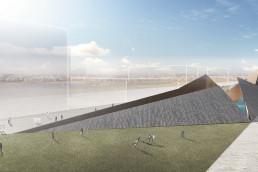
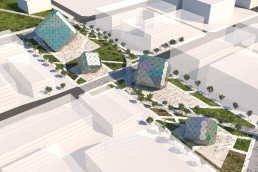
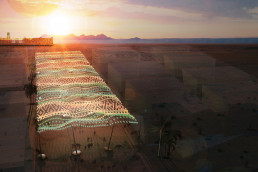
Lunar Cubit is a site specific proposal to be constructed in Abu Dhabi just outside Masdar City, the world’s first zero carbon metropolis once completed. Combining artistic vision with sustainable design and engineering, Lunar Cubit examines the nature of time through nightly contemplation of lunar phases and daily transformation of sunlight into electricity, powering up to 250 homes. Inspired by astronomy, quantum physics and the photoelectric effect, for which Einstein received the Nobel Prize in 1921, this work is open to the public, inviting a personal experience where one can literally reach out and touch a 1.74MW utility scale power plant, in the form of nine monolithic pyramids rising from the sands of Abu Dhabi.

Lunar means relating to or involving the moon and cubit is the name given to the oldest recorded units of length; employed though antiquity, the oldest cubit being the royal cubit, dating back to the Step Pyramid of Djoser circa 2,700 B.C.

Lunar Cubit is a timekeeper, a monthly calendar, allowing viewers to measure time through the eight lunar phases represented by a ring of eight pyramids encircling one central pyramid. All nine are proportional to the Great Pyramid of Cheops in Giza and scaled using the royal cubit but they’re not made from stone; they’re made of glass and amorphous silicon, giving them the appearance of onyx polished to a mirror finish. Supported from within, the façade of the pyramids is neatly seamless, like the face of a skyscraper, crisp against the heavens, reaching from base to tip, unbroken except for two silver streaks like rays of light scribing each face into two equal triangles and one diamond. Using frameless solar panels reduces embodied energy by nearly 30%, reducing time to be energy positive from seven years to five years. Around the pyramids flow natural stone paths in a repeating pattern that mirrors buried electrical cables, conducting electrons from the outer pyramids to the central pyramid where inside they are transformed into AC energy and transmitted to the Utility Grid. Co-locating walking paths and conduit runs minimizes the footprint of disturbed land during the construction allowing the maximum amount of natural ecosystem to remain untouched.

Nine pyramids resting on tan sand; encircled by distant trees; antiquity gilded with technology. Visitors are encouraged to walk amongst these clean power plants, beacons of science, rising to meet a hail of photons from 149 million kilometers away, traveling at the speed of light, to smash into electrons, jarring them free from their molecular bonds and channeling them into electricity. Day passes; a crown of shadows slides silently across the shrubs and sand as the sun rises and falls, moving across the sky and eventually disappearing below the horizon. Two pyramids begin to glow, rising in luminosity as twilight fades and the sky grows dark. Lunar Cubit illuminates inversely proportional to the lunar cycle and tonight is a new moon; white LED’s shine through thousands of tiny bands that are the cellular structure of amorphous silicon solar panels; creating a diffused glow that rises to become a solid pyramid of white light.

Accompanying the center pyramid is a corresponding outer pyramid, clearly marking the lunar phase like a number on the face of a clock. Inverted illumination creates a dance, an ebb and flow like the tides; pyramids of light reaching out to a hidden new moon and as the moon begins to shine, the pyramids recede, allowing moon light to fill the landscape. On the night of a full moon, only moonlight will trace a crown of silvery shadows across the desert floor until the following evening when the pyramids again begin to glow and the moon begins to fade; light forever rising and falling as the moon spins around earth, as the earth spins around the sun as the solar system spins around a massive black hole.

Located five kilometers from Abu Dhabi international airport, Lunar Cubit is visible from the air and creates a landmark, a destination for travelers to visit, relax and meditate. Nine pyramids form a ring matching near-bye road structures, forming a symbol of infinity. Lunar cubit serves as a reference, a familiar sight like Big Ben or the Empire States Building, safe, comfortable and timeless as the sun and moon.

Generating electricity for 250 homes, is a perfect complement to Masdar City, a symbol of imagination and sustainability. Harnessing the power of the internet to reach a wider audience, Lunar Cubit utilizes data monitoring, connecting the system’s output and usage to a website that anyone can visit and see live information; how much energy is being generated, how much is being used by the LED lighting, what are the weather conditions and details about the site.
Follow this link for a demonstration.

Art and renewable power generation are expanding frontiers. Our world is changing and the pace of change is accelerating rapidly. Lunar Cubit is a portal between past and future, combining art and energy, welcoming us to step into the future.

low-res version PDF of submitted boards

Tweet this!Tweet this!

Tags: ,

Climate Art Generator

Subarquitectura
Fernanco Valderrama Garre, Andres Silanes Calonge, and Calos Bañon
Designed for Site #2 in Abu Dhabi, between Saadiyat Island and Yas Island.


Design Submission for the 2010 Land Art Generator Initiative Design Competition

Artist’s descriptive text:
Global weather disturbances like global warming are proof that weather and climate are not impervious to human intervention. If we can alter the weather inadvertently – throught technological recklessness – we can also alter it willfully.

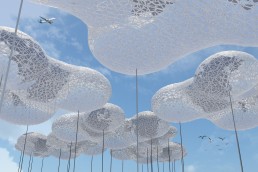
CLIMATE ART GENERATOR is what is trying to avoid, a human-induced climate change. It is contradictory, seemingly. Is a device that produces clean energy and generates a local climate change as an artistic experience. It is not produced by humans, just induced.

A great opportunity for us to rethink about the modern age culture of controlling everything. Weather is the center of a technological debate. Our cultural anxiety about the weather can be attributed to its unpredictability. As an expression of nature, the unpredictability of weather points out the limitations of technological culture. While advanced methods of detection and tracking help to warn and thus protect us from the ravages of nature, the weather is unstoppable. It’s beyond our control.

CLIMATE ART GENERATOR is not inspired by nature, is activated by nature. As a secondary expression of nature, hasn’t a constant shape. Is recursive, created by the weather and weather modifier. An alteration that unleashes a reaction.

It is the inflection point in a field of vectors. Form follows equation. It is mathematical. It has a maximum and a minimum. If stops, nothing happens. If nothing happens, stops. Can’t control it, just enjoy! It´s predictable as weather. It´s unpredictable as weather.

Activates human attraction to natural phenomena. Being local, concentrated, becomes tangible and therefore emotional. While changes in time, allows us to relate inputs and learn, an educational experience.

By avoiding CO2 emissions and cancelling their effects, is both preventive and active. Has a double positive impact. We use a hybrid strategy that combines global long term and a local short time consequences.

As a vertical windmill, it harnesses the kinetic energy of the wind to generate 1500kW of clean electricity. Doesn´t need to face into the prevailing winds, eliminating the need for a yaw mechanism. It works, but converting wind into electricity and transporting it means that a lot of energy is lost. In a more direct way, part of the energy generated is dedicated to pump sea water to the top, accumulating potential energy. There is no water accumulation. In a continuous process, water falls inside the blades accelerated by the force of gravity.

When you spray saltwater into the air, you create nuclei that cloud condenses around, creating bigger and whiter clouds, thus bouncing more sunlight back into space. The idea is to increase the amount of sunlight reflected back into space from the tops of thin, low-level clouds

Clouds are a key component of the Earth’s climate system. They can both heat the planet by trapping the longer-wavelength radiation given off from the Earth’s surface and cool it by reflecting incoming shorter wavelength radiation back into space. The greater weight of the second mechanism means that, on balance, clouds have a cooling effect.

A new type of oasis is created. As humidity rises, vegetation can colonize the plot. Mangrove trees grow in tropical and subtropical areas. With the natural availability of these shrubs in several coastal areas in the UAE, they can reduce desertification impacts.

Nobody knows the size of the CLIMATE ART GENERATOR. It´s as big as the effects that produces. It’s not dangerous but doesn’t seem safe. Is shaped like a catastrophe, but provides benefits.

low-res version PDF of submitted boards

Tweet this!Tweet this!

Tags: ,

Michael Jantzen
Designed for Site #2 in Abu Dhabi, between Saadiyat Island and Yas Island.


Design Submission for the 2010 Land Art Generator Initiative Design Competition

Artist’s descriptive text:
My design inspiration for site number two comes from a conceptual symbolic representation of the micro energetic interaction between photons of sunlight, and the release of electrons within photovoltaic cells, which in turn form electricity. This energetic interaction is symbolically represented for this competition as a large, pragmatic, scalable, abstract, three dimensional, stimulating and challenging form, capable of capturing energy from the sun, and converting it into electricity for the local community.

The basic structure would be constructed from a series of prefabricated panels, each fitted with a steel support frame, and covered with a colored concrete composite skin. These panels can be added or subtracted in order to scale the structure up or down and/or to change the shape at any time.

Minimal negative environmental impact is anticipated with this design because of the small amount of structure actually touching the ground. Also a minimal amount of foundation should be required with most of the land under the structure left open for human and animal passage.

An appropriate number of the south-facing panels would be covered with shadow tolerant, non-glass, high temperature performance photovoltaic film made by the Uni-Solar company. All of these panels are placed high enough on the structure so the visitors cannot reach them. In full sunlight with full exposure, the solar panels could generate approximately ten thousand watts of electrical energy for the local grid. I chose to harness energy from the sun with my structure since the sun is the most abundant form of alternative energy at the site, and is certainly symbolic of the desert environment in which the Solar Energy Field would be placed.

I think that those who visit the structure would see it as an amazing apparition or mirage in the desert that would soon become a world-known tourist destination. In addition, it would function as an oasis sheltering the visitors from the hot sun. Some of the lower panels of the structure fold out in different ways in order to provide places to sit or lie. There is also a stairs (leading to a viewing platform) built in under the structure so people can actually climb up into the Solar Energy Field for a better view of it and the surrounding landscape.

Two of the panels that form the structure fold out in different direction along the ground and become pathways leading visitors to and from the Solar Energy Field with access off of the main highway that connects Yas Island to Saadiyat Island.

low-res version PDF of submitted boards

Tweet this!Tweet this!

Tags: ,

Solar Flock

Katja Virta and Niko Knappe
Designed for Site #1 in Dubai, near Ras al Khor Wildlife Sanctuary.


Design Submission for the 2010 Land Art Generator Initiative Design Competition

Artist’s descriptive text:
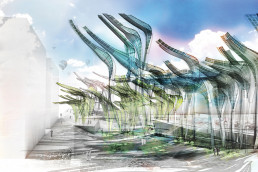
The Solar Flock represents a bird flock bathing in the sun, ruffling their feathers.

The Solar Flock acts as a middle ground between the built landscape and internationally acknowledged Ras Al Khor wetlands area, between the human ecologies and the natural habitats of diverse species.

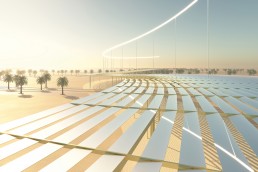
Solar panels are arranged in a form that resembles folded paper birds. It makes a reference to ancient wisdom, art, nature, science and even building. Instead of the high tech esthetics often employed in solar energy installations, the Solar Flock has a very simple and lean esthetic quality.

The flock of solar birds, bathing in the hot sun, signals the environmentally conscious efforts of Dubai in environmental protection and creation of ecological human habitats.

This array of human made nature is surrounded by huge building projects like Lagoon, Business District and Dubai culture district. The Flock acts as a landmark of Ras al Khor, and as a reminder of the wild nature.

Birds are constructed of three dimensional planes that have larger solar area efficiency compared to regular plane mounting. Large enough areas are used with thin semi transparent solar photovoltaics where as other planes act as a light reflecting and strengthening material. The alignment of birds is designed according to sun trajectory and wings follow the sun by simple 1-axis movement. Light sensors on bird heads will detect sun angle and direction.

One energy storage unit connects all birds and stores enough energy to light up birds during the dark, distributing the rest to the grid during the day. The darker it gets, the brighter the birds will become.

The Solar Flock installation is scalable, so that the flock can grow larger when needed. Also the type of birds can be varied, or more efficient species can be installed over time, according to the development of solar technology.

Birds are constructed around metal frames, that are sturdy enough to survive high wind & storm conditions. Surface material is semi transparent reflective photovoltaic thin film that let’s decorative LED lighting pass trough. System uses well known and tested photovoltaic based renewable energy production.

The installation profile is fairly low, so it leaves the views open to the shore. There are no visible technical installations needed, the electrical mains can be hidden underground. Cabling goes inside the ground through birds’ legs all the way to the energy storing unit.

Since the ground area needed for structures is minimal and the works are moderately light weighted, it does not require land clearing or other major land works.

low-res version PDF of submitted boards

Tweet this!Tweet this!

Tags: , ,

Solar Sound Field

Sage and Coombe Architects
T. Kelly Wilson, Timothy Dunne, John Parker, Richard Kress, Peter Hansen, Christoph Timm, Peter Coombe, Allen Slamic, John Reed
Designed for Site #2 in Abu Dhabi, between Saadiyat Island and Yas Island.

land art generator
Design Submission for the 2010 Land Art Generator Initiative Design Competition

Artist’s descriptive text:
One edge of this site is the line between two extreme conditions: the Rub al Khali and the Arabian Gulf. Here the desert meets water. The forms of our proposal are drawn from the interaction of the environmental conditions and the unique land forms of the Arabian Desert’s Empty Quarter.

Solar Sound Field responds to the scale of the site and creates an alternate landscape of forms that will be seen from afar while providing an unexpected and sublime experience for an individual visitor. The composition of objects across the site is reminiscent of geological forms found in the desert, the Jebel Tuwaiq for example. We created these primal forms as a child may play on a beach: we dig to expose water; we smooth the sand to create a protected place; we mound the sand to make a landscape; and we dig by the sea and watch as it invades.

land art generator

To generate electricity we harvest the most prevalent source of energy on the site- solar radiation. It is well established that all the energy stored in Earth’s reserve of fossil fuels from petroleum to coal, is matched by the energy from just three weeks of sunshine. Each square meter collects the approximate energy equivalent of roughly a barrel of oil each year, or 6 kilowatt-hours of energy every day in the desert.

Solar chimneys will capture energy from the sun’s heat and photovoltaic cells create energy from the sun’s light. We want to transform the latent energy of the site into a medium that can be seen, felt and heard. We give voice to the desert: we propose five musical machines and five accompanying musical compositions.

Each machine is designed and placed to address a unique condition of the site and provide a different orientation to the ground plain. The generated sounds, ordered and organized into modern compositions, and are acoustically matched to the spatial idea and position of the viewer as he moves from one chamber to the next.

land art generator

The Machines
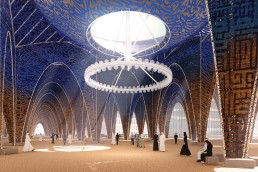
Each machine is a composition of three components: an acoustic chamber, a glass skirt and an array of chromium steel pipes- 60 meters tall. The elements of the site- water, sand and air are represented in glass, concrete and polished steel. The glass skirts will float above the sand like a mirage of water. The colour of water, sand and sky are reflected and distorted in the mirror finish of the pipes. The pipes will dissolve into the sky. The concrete is made from the surrounding sand and will be come a part of the ground.

land art generator

Air underneath the glass skirts at the base of the pipes will be heated by the sun and an upward directed airstream created by the hot and buoyant air wanting to rise. This airflow, similar to an organ, provides the means to sustain a musical note through the resonance chamber in each solar chimney. The pipes will channel the airflow that drives a simple turbine and generates electricity. Water storage underneath the glass skirt will be used to store heat so that the stack effect continues throughout the night. The harvesting energy will be felt and heard throughout the day.

In addition to the turbines, electricity is generated by of 24,000 square meters of photovoltaic cells placed below the glass skirts. The electricity created will provide power needed on site. Excess power will be fed to the grid.

land art generator

Parking Area
A continuous dune, made from the excavations or spoils from the sound chambers, lines the parking and provides an acoustical barrier to the road. Separate entrances punctuate the dune. A visitor, upon leaving the parking area, would pass through the dune and follow pathways that link each machine. Descending into the cool shade of each chamber the visitor will find a symphony of sound, space and light.

Machine 1 Amphitheatre remains an ‘instrument.’ The available sound is offered the visitor to manipulate, and to be used by visiting sound artists and musicians who come with the purpose to explore the form of generated sound.

Musical Composition 1:
Suspension Chamberland art generatorland art generatorland art generatorland art generatorland art generator
Here the unpredictability of the converging counterpoints – disparate and dynamic voices unpredictably bouncing off one another – form moments of intense epiphany and inner-directed rumination engendered by an encounter with the surrounding spaces and energy.

Machine 2 Water permits the confluence of tidal water within the sound chamber, low frequency notes at the limit of human hearing visually observable on the surface of the water, registering their notes with pressure.

Musical Composition 2:
Performance Chamber
Out of the stillness of the water grotto rises a sonic wave of resonating low frequencies. The cluster of tones first presents itself as an inaudible sound wave somewhere that sends ripples over the surface before modulating and becoming humanly audible. Our eyes are presented with one image of water and faint light and our ears remind us of their voluminous powers.

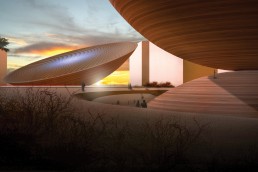
Machine 3 Sky slides land beneath an inverted dome that is pierced by an oculus, brings the visitor to direct their gaze toward the sky.

Musical Composition 3:
Water Chamber
With a blast of direct sunlight at the center of this massive disc the heavens cut through our senses like the bright, soaring major harmonies created by layers upon layers of melodic threads. The sun’s radiance appropriately trails-off into the sounds of creation – birds of the sky.

Machine 4 Wadi develops a long and gradual swale to pass gently under the land, slowly approaching the sound field beneath the pipes above where the slow gradient of descent compliments the gradient of sound.

Musical Composition 4:
Sky Chamber
Two wind instruments, like comforting messengers from the heavens directed columns and conversing a tonal language at home in the Arabic culture, beckon the visitor along a graded pathway leading further into a blissful unknown.land art generator

Machine 5 Canyon directs the visitor into a deep trench down a ramp, to cross a bridge poised exactly at the mid point between top and bottom of the trench. With equal measures of space above and below, the visitor is placed in a suspension from ground and sky.

Musical Composition 5:
The vast stretch of upwards and downwards space is not inert but charges with the sound of arching and jubilant brass. Suspended and locked into some kind of celestial dance above the insistent gravitas of the string bass pizzicatti the stifled awe of an encounter with the sublime is given over to joyously pulsating celebration.

Scientific Principles: Solar Updraft Function of LAGI
The basic function of LAGI is to use the heating of air as in a greenhouse to produce power from updraft to turn a turbine.

The project consists of five differently geometrically shaped machines which operate independently from one another. They are located at distances of 100 to 400 meters apart.

Functional Principles
The function of each of the five machines can be divided into three parts, each of which derives from traditional and conventional technology.

1. Greenhouse– heating of the air,
2. Chimney– upward motion of hot air through the towers, and
3. Turbines– generation of electricity by turning of a turbine.

Greenhouse
The solar radiation penetrates the glass roof of a greenhouse a heats the air below. This is similar to what happens in a car parked in the sun, the air will heat up until there is an equilibrium of the energy irradiated into the box and the total of the energy radiated out of the box and the energy loss by heat conduction through floor, walls and roof.

The real model must include the loss of the hot air to the actually not enclosed “box”. A dynamic flow model includes inflow of cold air into the greenhouse, transport of that air through the greenhouse structure while the air is heated, and loss of hot air from the greenhouse to the chimney(s).

Chimney
Hot air rises as it is less dense than cold air. The rising hot air from the greenhouse or glass skirt turns powers the turbines.

Turbines
To calculate the potential for energy production from the turbines placed in the solar chimneys we have looked for existing installation that may serve as precedent.
Power Calculations and Precedent Projects

low-res version PDF of submitted boards

Tweet this!Tweet this!

Tags: , , , ,

An Ode to the Sun

Boulos Douaihy
Designed for Site #2 in Abu Dhabi, between Saadiyat Island and Yas Island.

land art generator
Design Submission for the 2010 Land Art Generator Initiative Design Competition

Artist’s descriptive text:
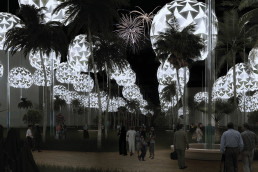
Our installation is a celebration of the sun’s “aura” on earth. It emphasizes the sun’s cycle during the day and year and quantifies and shows the energy produced by sunlight.

A forest of metallic geodesic spheres with a photovoltaic hemisphere rotate on their axis following the movement of the sun during the day, collecting sunlight and transforming it into electricity stocked in underground batteries, allowing their rotation.

land art generator

The energy collected during the day will be exposed during the night through light emitted from the same photovoltaic hemisphere. The more energy collected, the more the light is intense. Summer nights being the most lit.

The spheres start the day by welcoming the first sunrays at dawn and follow the sun’s path becoming self-sufficient sun watches. During the night, the spheres become lit crescents seen from afar, indicating the night time.

land art generator

The Moon and the Sea

Our installation emphasizes the effect of the sun and moon on the sea by exaggerating the tide’s action on the shore’s outline.

The land, bound by the highway on one side and open to the sea on the other, is topographically manipulated to form mounds of different levels creating platforms hosting the spheres and disappearing into the sea.

As the tide goes up, the water surrounding the mounds create islands of variables sizes and shapes, continuously changing the shore line and putting the “photovoltaic spheres” in different situations.

land art generator

Sun Islands

Visitors to the “sun islands” can examine the spheres from the highway or can go island hopping and experience the different outlines created by the tide.

During the day, the spheres create shaded spaces allowing for potential camping or picnic spots. During the night, the spheres light up the park , where different activities can take place: jogging, music festivals, stars watching etc…

land art generator

low-res version PDF of submitted boards

Tweet this!Tweet this!

Tags: ,

Egal Center

Celestino Sebastiao
Designed for Site #3 in Abu Dhabi, on Airport Road near Masdar City.


Design Submission for the 2010 Land Art Generator Initiative Design Competition

Artist’s descriptive text:
The vision is centered on integrating multi disciplinary fields knowledge to explain conceptual principles of design for a nature friendly power station that employs gravitational force to generate large-scale electricity (760 megawatts / peak).

Sustainable Architecture and Art – Precepts taken in consideration for site selection are related to specific constrains when analyzing features of urban development and consolidation, spatial distribution and specific characteristics of public services and equipments. In terms of impact on nature, a specific desk assessment has been carried out for each proposed site based on land utilization, impact on local fauna and flora, underground water disturbance and changes on wind flow. The proposed building footprint is a result of a study of United Arab Emirates traditional architecture of Forts and Mosques also its unique landscape features namely desert dunes. Therefore, three-separated irregular curvilinear type of structurally disintegrated solids has been adopted for the proposed building ground floor plan set up. However, a basement floor area, an outdoor public terrace located on the first floor, and finally a common roof element, interconnects these solids. The combination of built and empty roofed outdoor public spaces allows for the provision of shading areas on which natural ventilation will be taken into the building also allowing for daylight use. Finally, this strategy will help with the migration movement of birds nesting on the edge perimeter green buffer zone that will be protected integrally although detailed study on underground water disturbance may necessary as to assess any constrain caused by the proposed basement area. The proposed sculptural center will be spatially organized in the following manner:

A) Access restricted basement area to house industrial generators, the rotation system, and high voltage transformers, connection cabling equipment connecting to local power grid.

B) Ground floor area composed by 2no gravitational field spaces on which the solid bouncing displacement or gravitational tubes are installed and concealed on lattice structural elements. Postmodernism art galley area for public to contemplate the complexity of bouncing solid displacement along gravitational tubes based on stability of space objects which are used as force to generated large-scale electrical power. This floor will be built in structural masonry walling system with optimized opening and finished accordingly so to provide a clear barrier between outside and inside spaces.

C) First floor area with the same space arrangement from the floor below and composed mainly by a void space formed by gravitational fields in continuation from ground floor area. Learning facilities, management and technical control rooms and dedicated welfare areas finally, public outdoor panoramic terrace.

Geometrically, this floor is designed through orthogonal section of cones built using steel frame structures, which loads on ground floor structural walling system. These towers will be internally finished with frameless curtain walling system with opening units so to form a thermally controlled interior space and externally will be sculptured using a system of vertical repeated waved sun shading elements which design is inspired by the bending of Egal ropes also optimized through profitable variation, an important aspect of natural selection process.

Gravitational Field. Firstly, the term gravitational field is used in this context to designate the entire system composed by singular gravitational tubes assembled at a specific space, therefore, the proposed power station will contain two separated gravitational fields. Secondly, gravitational tube is designed to produce force by displacing up and down a homogeneous solid along a gravitational axis. The massbouncing solid is submitted under three basic quantum mechanics law:

1) Law of Equilibrium (static condition) Newton’s third law F1=F2, F1+F2=0

2) Law of gravity (moving down) Newton’s second law F=ma

3) Law of elasticity (bouncing up) Robert Hooke’s law F=k.x (series and parallel equation for forces acting along springs)

To maintain a self constant solid displacement along a gravitational vector, a system of acceleration valves are designed to help the system to regenerate its own momentum hence a series of displacement state can be written in this way:

a) Initial displacement (2 ➔ 3 ➔ 1 ➔

b) Auto regulated bouncing displacement (➔1 ➔ 2 ➔ 3 ➔

The stage 1 will be obtained through the design and diagram of forces acting along acceleration valves components, which will allow for a temporary decrease of acceleration in a period of time in between 5 to 10 sec. The bouncing gravitational system will be formed or constructed with the following components:

1) Supporting steel shell structure
2) Upper chamber with releasing and stopping devices connected to expanding holding encapsulated torus chain connected to spiral hairspring boxes and the displacement solid.
3) Stabilization box with tension spring to provide weight displacement with homogenous type of movement and help regulating the speed.
4) Bouncing solid or weight with a properly designated mass in kg will produce force used to rotate an electrical generator turbine.
5) Displacement axis or gear bar connected to the bouncing solid and used to direct the generated force to articulation lever arm located at rotation and torque box.
6) Tension box with impacting head and multiple spring coils arranged in discs and displaced in parallel (keq=k1=k2) and series (1/keg=1/k1+1/k2) patterns.
7) Rotation and Torque Box (r=r.f) to house the rotation torque that converts vertical force into rotation force applied on the rotation of a wheel system attached to an electrical generator blade through a chain system.

The design principles will consider the value of 760 megawatts/peak of electrical power production for future mathematical and physic modelling of gravitational tubes (76no gravitational fields x 2no generators of 5 megawatts capacity for each tube).

However, flexibility factors will be considerate as data for required amount of power should be provided by concerned authorities rather than being imposed by design limitations.

Development. The proposed sculptural power station is a result of interconnecting collaborative fields of knowledge with the intent of building world first conversion of force produced by stability of space objects along a gravitational field into a specific required amount of needed electrical power.

Therefore, overcoming issues related to storage or lack of enough force to produce the required amount of power as it has been happening with other forms of renewable sources. These factors allows the system to be universally valid without compromising its performance due to geography, time of the day and weather conditions. Further, the concept opts for versatility as it bases its design on single independent unit working to form a flexible and expanding system. Egal center will be an art installation that uses its bouncing system as asset for establishing an advance postmodernism art gallery and learning facilities dedicated to innovative ideas of applying scientific knowledge to resolve mankind needs and will be also make a positive contribution on the strategy of opting for a type of architecture that is a result of adaptive approach rather than the importation of archetypes.

Finally, we appreciated the initiative and used it as conceptual experimentation fusing different aspects of technological innovation which may leads for an efficient kind of sustainable development concentrated on providing the humanity with the next stage of freedom and security which comes with the feeling of saving our unique and only habitat, the Earth. It is more than the freedom experienced with the invention of aircraft.

low-res version PDF of submitted boards

Tweet this!Tweet this!

Tags:

Static Motion

Sherri J. Newman and Jen Earle
Designed for Site #3 in Abu Dhabi, on Airport Road near Masdar City.


Design Submission for the 2010 Land Art Generator Initiative Design Competition

Artist’s descriptive text:
The concept for our land art generator is a response to the conditions of its environment. This was accomplished through site movement and patterns, local climate, and cultural geometry.

The viewing platform for the Land Art Generator will take place from the frame of a window, as local Abu Dhabi citizens and tourists circulate around the site. The movement, both by highway and airplane traffic from Abu Dhabi’s International Airport informed the design of the structure with the intention of conveying a sense of motion from within a static object. The subject would view the sculpture from the reference point of a car or airplane window and as the viewer rotates around the object varying perspectives are produced from different angles and in three dimensions.

Smart textiles are layered over the sculpture as a temperature sensitive skin accomplished by thermochromic dyes. As the ambient air temperature and light intensity change throughout the course of the day, the textile would vary in color and effectively act as both a visual thermometer and indictor of how much solar activity is being collected by the installation, giving a visual tangibility and aesthetic quality to clean energy consumption. Responsive textiles allow for environmental readings that will engage citizens.

The underlying geometry of the form is based on tangents, utilizing the cultural significance of triangles in Islamic architecture. An organic form emerged from this geometry, by patterning catenary curves around tangent points. Finally, the pattern used to layer soft PVCs onto the textile was inspired by the texture of date fields surrounding the site; evident from aerial views.

The lightweight, tensile design allows for minimal environmental impact, and a chance to present solar energy to a new generation of consumers.

The island,
carved by the machine,
fluid lines of the outer shell display the dynamic force,
motion contains the object,
Impenetrable boundary.

Nature maintains the periphery,
Containing from within,
The vastness of the island.

The object,
Engaging,
contained at rest,
invites the subject,
into motion.

low-res version PDF of submitted boards

Tweet this!Tweet this!

Tags: ,

Michal Teague and David Moore
Designed for Site #3 in Abu Dhabi, on Airport Road near Masdar City.


Design Submission for the 2010 Land Art Generator Initiative Design Competition

Artist’s descriptive text:
Sunset (running on empty) is a counter monument heralding the sunset of the era of petrol-based car culture. It comprises a purpose made video artwork shown in a replica installation of the iconic drive-in cinema, featuring a large screen, advertising marquee and car park that is the electricity-generating component of the design. The video artwork is a temporal-based narrative depicting a car driven continuously until the petrol tank runs dry. The car will remain permanently parked in the middle of the renewable energy generating ‘car park.’

The drive–in cinema is an icon of the 20th century. Sunset (running on empty) acts as a counter-monument marking the sunset of large petrol-guzzling cars. A drive-in cinema is an artefact from a carefree era, before knowledge of climate change and the finite nature of carbon-based resources.

The word ‘Sunset’ refers to the end of the day, and the inevitability of change, it is also commonly used to describe an era that is coming to a close, as well as being a popular name during the heyday of the drive-in cinema.

The drive-in cinema initially seems deliberately out of context in the UAE. A nostalgic folly from another time and place. However, it speaks to the global and interrelated nature of the need to adopt clean and renewable energy sources.

Drive-in cinemas were traditionally sited on the outskirts of a city with easy access to a main roadway similar to the conditions existing at Site 3 Abu Dhabi. The advent of the VCR and increasing land value, meant that many have now become shopping centres and housing developments. The drive-in like oil is becoming scarcer, there now being only 700 odd left in the world.

Video installation–a car is filled with petrol then starts its final drive in and around Abu Dhabi. The drive is documented until the petrol is finally used up, eventually coming to rest at its final parking site the Sunset drive-in cinema.

Screen – known in the original vernacular as a ‘sheet.’A large outdoor screen powered by an open solar field. It is envisaged the screen will be placed in a westerly direction on site, approximating where the sunsets.

Marquee–an illuminated sign advertising the session times of the film ‘Running on Empty’ to people passing the site.The title can be interpreted literally as referring to the fuel gauge of a car and more broadly fossil fuels becoming scarcer. Additionally nuance comes from the two ‘coming of age’ genre films both titled ‘Running On Empty’. An Australian film made in 1982 featuring a young man involved in street drag racing and a 1988 U.S. production about a fugitive family on the run from the FBI and the eldest son seeking to live a life of his own.

Parked car – the ordinary car is permanently parked on site in the midst of the electricity-generating field after featuring in the video production.

Ramps– a replica of a Drive-in Cinema car parking area laid in a fan-shape. Rather than the more traditional material of asphalt it will be anelectricity-generatingfield with the solitary car, mutely watching itself on screen.

Option A: The preferred technological option for this component of the installation is to use Solar Roadway technology currently undergoing prototyping in the U.S. Having communicated with the developers full-production is probably 2 years off. However it would provide the option of the audience being able to safely walk or even drive on the electricity-generating surface. The product can also have LED lights embedded to create patterns, images and text. In respect to dust and sand, it will be able to be cleaned when required using a street sweeper.

Option B: a ‘car ramp’ formed by a black field of currently commercially available photovoltaic solar panels.

The dominant features of Site 3 Abu Dhabi – Airport Road near the Masdar City Site, are the surrounding roadways that delineate its boundary. The art installation foregrounds the role of the car and human behaviours, which influence the site, just as much as the naturally occurring phenomena – wind, sun, wildlife, vegetation, and occasionally water. In this way, the drive-in cinema installation is truthfully integrated into the surrounding environment and landscape.

The solar electricity-generating field will cause minimal interference with the ground of the site. The natural vegetation of the site would be permitted to grow in and around the art installation to enhance the feeling of it being an abandoned place from another time.He design uses a portion rather than the whole site.

Solar roadway 300 panels would generate 2.28MWhr – based on 15 % efficiency and a conservative 4 hours of sun per day. While 500 panels would produce an estimated 3.8MWhr.

The project design aims to be accessible to pedestrian foot traffic. With the solar roadway technology there is the potential for it to become a playground for the public. This would occur by using the embedded LED lighting to create games and maze designs for example.

The screen and car park ramps have the potential to become part of the public infrastructure of Abu Dhabi becoming a site to stage events and to screen the work of video artists during film and arts festivals rather than a static art installation.

low-res version PDF of submitted boards

Tweet this!Tweet this!

Tags: ,

« Older entries